I. Project Background & Key Challenges
In late 2024, a boutique hotel in Brisbane, Australia, planned a full renovation of 30 guest bathrooms and shower areas. The existing walls were ceramic tiles, which after 8 years showed:
- Cracked grout allowing moisture penetration, leading to black stains and musty odors at the wall base.
- Three rooms had loose tiles at risk of falling off – a clear safety hazard.
- Using the traditional method (demolish old tiles, redo waterproofing, re-tile, grout) would take an estimated 7 days of downtime per room. For 30 rooms, the total project would exceed 2 months – unacceptable for the hotel's operation.
The client had previously tried PVC foam wall panels in other areas, but within two years they saw bulging, multiple scratches, and slight deformation near the shower heat source.
Their clear requirement:
"We need a waterproof wall cladding that can be installed directly over existing tiles, is heat-resistant, impact-resistant, and produces no dust or odor during installation."
II. Why SPC Wall Panels? A Technical Overview
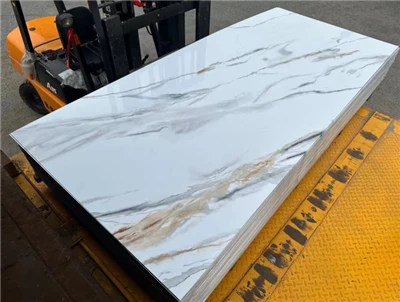
SPC wall panels consist of marble powder (approx. 60-70%) + PVC resin (approx. 30%) + stabilizers, extruded at high temperature. Compared to ordinary PVC foam wall panels, the main differences are:
- Density: SPC density ≈ 1.8-2.0 g/cm³, much higher than PVC foam (0.5-0.8 g/cm³) → SPC is harder and more impact-resistant.
- Coefficient of thermal expansion: SPC ≈ 0.06 mm/m·°C, PVC foam ≈ 0.1-0.15 mm/m·°C → SPC is more stable in shower areas with large temperature swings.
- Water absorption rate: SPC < 0.1% → can be soaked long-term without swelling. PVC foam's core absorbs water and swells once the surface film is damaged.
In simple terms: PVC foam wall panels behave like "hard sponge" – SPC wall panels are like "thin stone slabs".


Below is a detailed performance comparison with ceramic tiles and ordinary PVC foam wall panels.
Table 1: SPC Wall Panels vs. Tiles vs. PVC Foam (Core Performance for Wet Areas)
|
Performance Parameter |
Ceramic Tile + Mortar |
Ordinary PVC Foam Panel |
Haining Longtime SPC Wall Panels |
|
Weight per m² (incl. installation layer) |
30-40 kg |
3-5 kg |
3-5 kg |
|
Waterproofing (long-term soaking) |
Good, but grout is a weak point |
Fair (leaks at joints/damaged film) |
Excellent – dense core + click lock + sealant gives monolithic waterproofing |
|
Surface scratch resistance (pencil hardness) |
Mohs 6-7 |
≤HB |
≥2H (reinforced UV coating) |
|
Heat deflection temperature |
>200°C |
≈50-55°C (softens under hot water cup) |
≥75°C (tested for direct shower hot water) |
|
Installation method |
Wet installation, curing needed |
Glue or staples |
Click-lock system – direct installation over old substrate, optional adhesive |
|
Installation time per standard bathroom (≈5 m² wall) |
2-3 days (incl. curing) |
0.5-1 day |
0.5 day (direct install, no demolition) |
|
Recyclability |
Partially (crushed as aggregate) |
Difficult (foam + film separation) |
Closed-loop recyclable – can be crushed and remanufactured |


III. Product Specification for This Project
The client selected the Haining Longtime LT-SPC-W120 series. Key technical parameters:
|
Parameter |
Value |
|
Total thickness |
3.8-4 mm |
|
Board dimensions |
2400-3200 mm (customizable) |
|
Click lock type |
Folding click lock (Unilin style, allows 0.5-1 mm installation gap) |
|
Surface finish |
Matt synchronous embossing + anti-UV layer (3000h QUV test ΔE<2) |
|
Formaldehyde emission |
ENF level (not detected) – low VOC, safe for indoor use |
|
Combustibility class |
B1 (difficult to ignite, self-extinguishing) |
|
24h water absorption thickness swelling |
0.08% (SGS report) |
|
Impact resistance |
No cracks (drop ball test: 1 m height, 500 g steel ball) |
For Queensland's high-UV climate, this batch received an extra-thick UV coating to ensure no fading even in semi-outdoor shower areas.


IV. Installation & Results – Direct Over Tile Installation
The client used the direct-over-tile method: only cleaned the old tile surface, spot-applied anti-mold construction adhesive (optional – the click lock alone is sufficient), assembled with folding click lock, and finished edges with trim strips and anti-mold sealant.
Key Performance Comparison
|
Comparison Item |
Estimated Traditional Tile Renovation |
Actual SPC Wall Panel Execution |
|
Total construction days (30 rooms) |
≈60 days (demolition, leveling, waterproofing, tiling, grouting) |
18 days – 70% faster |
|
Labor cost per room |
≈AUD 1,200 |
≈AUD 700 (42% reduction) |
|
Total material weight (30 rooms) |
≈4,800 kg |
≈1,150 kg (76% reduction – lower floor load & shipping cost) |
|
Noise complaints during construction |
High (tile cutting, electric demolition) |
Nearly zero – cut with utility knife / circular saw, no dust |
|
After-sales issues (first 3 months) |
Estimated at least 2-3 grout cracks or loose tiles |
0 issues |
Client feedback (hotel engineering manager):
"Haining Longtime's SPC wall panels allowed us to complete the renovation within our low-season window, avoiding any overtime penalties. Workers didn't need masks, and guests hardly complained about noise. Another property in our group on the Gold Coast has now adopted the same solution."
V. Certifications – Global Compliance for Hotel Renovation Projects
Haining Longtime SPC wall panels carry the following independent third-party certifications:


Copies of certificates and reports available upon request. Some certifications apply to both SPC wall panels and SPC flooring.
VI. FAQ – Common Questions About SPC Wall Panels
FAQ
Q1: Can SPC wall panels be installed directly over old ceramic tiles? What substrate is required?
A: Yes – this is one of their main advantages for bathroom renovation without demolition. The old tile surface must be reasonably flat (≤3 mm deviation over 2 m straightedge), free of loose tiles, and free of heavy grease. Just clean and fix any hollow areas. No need to remove old tiles.
Q2: How does the price compare to PVC foam wall panels? Is it worth the extra cost?
A: Our SPC wall panels are typically 20-35% higher in ex-factory price than PVC foam panels of the same thickness. The extra cost brings: a much denser stone-plastic core, a UV scratch-resistant coating, and a higher heat deflection temperature (≥75°C vs. ≈50°C for PVC). For wet areas, high-traffic commercial bathrooms, or spaces with temperature variation, the total life-cycle cost of SPC is actually lower – because you avoid bulging, scratches, yellowing, and callbacks.
Q3: Are SPC wall panels suitable for shower walls that get direct water spray every day?
A: Absolutely. This Brisbane hotel project used them exactly that way – direct spray in guest showers. With proper installation (click lock + anti-mold sealant on all joints and corners), SPC panels create a monolithic waterproof layer. Important: they do not replace the in-wall waterproofing membrane. Ensure the existing waterproofing is intact or apply a new coating before installing panels.
Q4: Do I need to leave an expansion gap during installation?
A: Yes. SPC has a low but real thermal expansion/contraction. We recommend a trim strip every 3-4 meters or leaving about 1 mm of natural movement (the click lock provides some play). At wall corners and the ceiling, cover a 5-8 mm gap with trim strips.
Q5: How do I clean the surface? Will limescale stick?
A: Daily cleaning with a damp cloth or neutral detergent is fine. The UV layer is stain-resistant and fingerprint-resistant – ordinary limescale does not easily adhere. If white marks appear after long use in hard-water areas, wipe with diluted white vinegar then rinse with clean water.
Q6: Can SPC wall panels be used for curved walls or pipe cladding?
A: SPC is rigid and cannot be cold-bent. For columns or small-radius curves, you would need custom narrow strips or thermoforming (factory pre-treatment). For standard square pipe cladding, cut the SPC panels directly and finish with trim strips.
Q7: Do you have stock samples and colors? Can you send samples internationally?
A: Yes. Standard stock colors: linen white, light grey sandstone, warm grey wood grain, smoked oak. We can provide 200 mm × 200 mm samples and ship internationally by small parcel. For custom colors and surface textures, please contact our sales team for MOQ details.
VII. Best Applications for SPC Wall Panels (Based on This Case Study)
Based on the Brisbane hotel project, SPC wall panels are especially recommended for:
- Hotels, apartments, office buildings – fast bathroom/shower renovation requiring low noise and short construction time.
- Home renovation – when you don't want to remove old tiles and want to use the room the same day.
- Basements, laundry rooms – long-term high-humidity environments.
- Public spaces with environmental requirements – ENF no-formaldehyde, low VOC, recyclable.
Note: SPC wall panels are not suitable for long-term submersion (e.g., swimming pool bottoms), nor for direct installation over extremely uneven walls (height difference >5 mm/m without preparation).

VIII. About Haining Longtime
Haining Longtime Industry Co., Ltd. is a vertically integrated manufacturer of SPC wall panels. All processes – substrate extrusion, inline embossing, UV coating, and click-lock cutting – are owned and controlled in-house. Our products carry CE, FloorScore, ISO 9001 and other certifications. We offer custom UV formulas, wide boards (up to 900mm), anti-mold back layers and other regional adaptations.
For samples or technical inquiries:
- Website: https://www.longyuanpanels.com/
- Email: ltfriend01@jxlongtime.com.cn
- WhatsApp: +86 173 7761 1682
- Phone: 0086 173 7761 1682