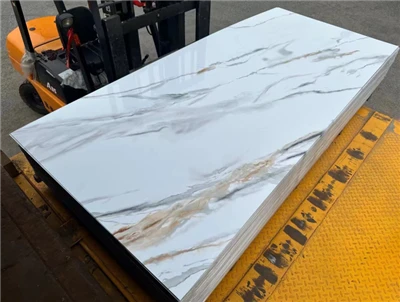
Many interior wall projects do not fail because of the design. The drawings look great, and the material-marble, tile, or wood veneer-has already been selected. What actually stops the project is whether the wall can carry the load, whether the color matches from batch to batch, whether the schedule can be held, whether it will look worn in two years, and whether the budget can actually land.
The five scenarios below come from real renovation and new-build projects. Each problem is paired with what UV marble sheet actually does and the numbers behind it. This is not a product brochure. It is more like a field note on material selection and avoiding the usual traps.
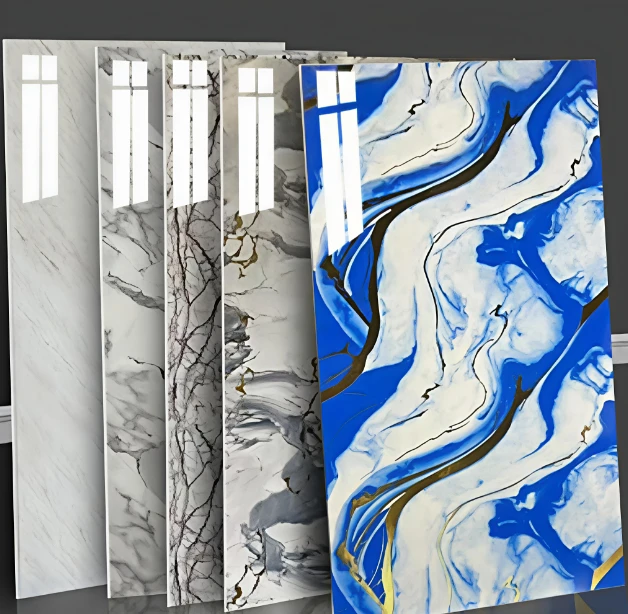
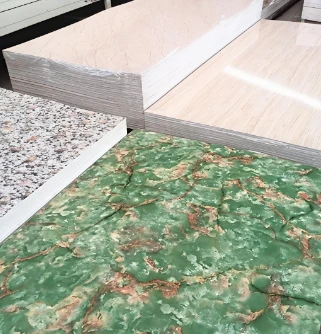
First, a quick clarification: What is UV marble sheet?
It is not a sticker, and it is not an ordinary PVC panel. It uses a high-density calcium powder or PVC composite core, with a digitally printed marble texture on the surface and multiple layers of UV-cured coating. The standard size is 1220 × 2440 mm, 5 mm thick, and it weighs about 9.5 kg/m². It can be used on interior walls, elevator lobbies, corridors, bathrooms, and retail fitting rooms.
Problem 1: The existing building can't carry the load, and natural stone overloads the wall
- Typical failure point: In apartments, office buildings, and commercial corridors from the 1980s and 1990s, partition walls were never designed for stone loads. 20 mm natural marble weighs about 38 kg/m². Add backing board, mortar, and framing, and many walls go straight over the limit. In the end, the specification gets cut back to paint, and the corridor still looks old.
- The UV marble sheet approach: A 5 mm panel weighs about 9.5 kg/m², roughly one-quarter the weight of natural stone. No stone backing board. No added steel framing. It bonds directly to the existing substrate.
Case: Corridor renovation in a 12-story apartment building in Tel Aviv
When contractor Eitan took on the project, the owner wanted a "natural marble feel," but the material budget was only $60/m². He first tested UV panels from several suppliers. Some blistered as soon as they were hit with a heat gun; others had a surface that felt like plastic wrap. Then he received a sample from Haining Longtime Industry Co., Ltd., with a note attached: scratch it with a key. The scratch wiped away with an alcohol swab.
In the end, he used 5 mm, 9.5 kg/m² UV marble sheet, applied directly over the original walls. A crew completed 720 m² of corridor in eight days, with no structural reinforcement. For old-building renovation, that one point decides whether the material can be used at all.
Problem 2: Natural stone color variation makes 200 rooms look like 200 different stones
- Typical failure point: This is not a defect of natural stone. It is a property of it. From the same quarry, across different batches, or even within a single block, veining density, background tone, and mineral spots all vary. For a hotel with 200 bathrooms or a retail chain with 40 stores, if natural stone is used, it is very hard to make every room look consistent. Replacement panels later are even worse-a new batch may not match at all.
- The UV marble sheet approach: The marble texture is digitally printed, and both the core and coating are controlled in a stable process. Within the same production batch, color difference can be held to ΔE 0.8 or below. That number means most people can no longer tell the difference with the naked eye when panels are viewed side by side. Vein placement can also be replicated, so multiple panels on one wall do not look like mismatched stone fragments.
Case: A 212-room hotel near Chicago O'Hare Airport
The hotel used UV marble sheet on bathroom walls and vanity surrounds. The general manager later reported that with natural stone, the veining was different in every room and looked disjointed; after the same-batch UV panels were installed, the rooms had a consistent look. Six months later, guest satisfaction related to room aesthetics rose 14%, the property received Preferred Plus status on two platforms, and direct booking conversion rose 22%.
Problem 3: The schedule can't drag, because every day the space is offline burns money
- Typical failure point: Installing stone and tile on walls is a multi-trade, multi-day job. Substrate prep, mortar, cutting, grouting, curing, sealing-the full sequence can keep a hotel corridor, restaurant, or retail store closed for a long time. In an occupied building, noise, dust, and wet work also generate complaints.
- The UV marble sheet approach: Structural adhesive bonds it directly to the old wall. Drywall, skim-coated walls, even old tile surfaces are acceptable. No demolition. No wet work. No curing wait. One person can install 45–60 m² per day. A 10 × 10 ft accent wall goes up the same day, not next week.
Data point: In the Tel Aviv corridor project, a crew completed 720 m² in eight days. A traditional natural stone approach-including backing, wet cutting, and curing-usually takes six to eight weeks and requires a larger crew. For commercial projects, schedule compression is not a "convenience." It directly decides whether the project can be done.
Problem 4: High-traffic spaces wear natural stone down
- Typical failure point: Looking good in a showroom does not mean it will hold up in a hotel lobby, hospital corridor, or retail fitting room. Keys, luggage, cleaning carts, and shopping bags leave impact marks and small chips. Natural stone is also acid-sensitive and stain-prone, and it needs regular sealing. If one section is damaged, the repair is hard to hide.
- The UV marble sheet approach: The UV-cured coating can reach a pencil hardness of 2H or higher, while ordinary PVC film is usually only HB. Hardness translates directly into resistance to daily scratches. Stain resistance reaches grade 5: red wine, coffee, and soy sauce left for 24 hours wipe off without penetrating. The non-porous surface needs no special cleaning chemicals.
Case: Fitting rooms and checkout counter at a clothing store in Vancouver
The store originally chose natural marble, but keys and shopping bags caused small chips. After switching to UV marble sheet, it passed 500+ impact cycles with no visible damage. Store data later showed that fitting rooms with this finish had 18% longer customer dwell time and 12% higher conversion. It also works in healthcare and food-service spaces, standing up to common cleaners, grease, and mild acids. Indoor service life is generally 15–25 years, with no waxing or polishing.
Problem 5: The budget is never enough, and the stone quote blows it immediately
- Typical failure point: The client wants marble, but the budget only covers laminate. The gap is not small. The total installed cost of natural stone-material, labor, sealing, and maintenance-commonly runs $50–200 per square foot. For a multi-floor commercial renovation or a residential lobby, once that number appears, the specification is dead.
- The UV marble sheet approach: The cost structure changes in three places: material, labor, and maintenance. Material runs about $5–15 per square foot. Installation costs less because the panels are light, can be cut with ordinary tools, and are bonded with structural adhesive-no stonemasons, wet saws, or curing period. Maintenance is a damp cloth. All told, many projects can come in at roughly one-quarter of a natural stone package.
Case: The budget math on the Tel Aviv project
Eitan's client had a material budget of $60/m², and local natural stone was simply not available at that price. UV marble sheet delivered the "natural marble look" the owner wanted and eliminated the structural reinforcement. Eitan later told me this project let him take on stone-budget jobs without being dragged down by stone timelines and margins.
Summary: Which interior spaces are best suited to UV marble sheet
The best-fit spaces usually meet three conditions at the same time: the existing substrate can accept adhesive-mounted panels, traffic is medium to high, and the desired look is a polished stone effect.
Good fits:
- Hotel corridors and bathrooms
- Apartment lobbies and elevator bays
- Retail fitting rooms and checkout counters
- Healthcare waiting areas and patient-room accent walls
- Restaurant restrooms and bars
- Residential feature walls, especially where budget or load-bearing limits rule out natural stone
Poor fits:
- Exterior walls with long-term direct sun exposure
- Walls with structural movement greater than ±2 mm
- Projects where the client must feel the weight and temperature of real stone to be satisfied
In the end, these five problems are not about the panel itself. They are about whether the constraints downstream were thought through at the moment of material selection. UV marble sheet does not replace natural stone everywhere. It provides a workable option when load, batch consistency, schedule, durability, and budget make natural stone the wrong choice.
Send your project details for a free specification check.
Send us the wall substrate, approximate area, traffic level, and the look you want. We will help confirm panel thickness, adhesive recommendation, and batch-matching plan before you decide whether to use this material.
Send your project details for a free specification check.
Haining Longtime Industry Co., Ltd. manufactures UV marble sheets and related decorative wall panels. Standard size is 1220 × 2440 mm, thickness 3–6 mm, with custom lengths up to 3.0 m. UV coating thickness is 0.3–0.5 mm, with batch color control and optional fire-retardant configurations.