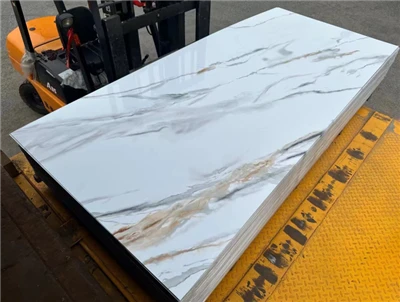
"At the worst point, we were getting seven or eight return complaints a month about scratches on the surface of our ceiling panels. The goods had already arrived at the job site. The installer opened the box, and the panels were covered in scratches. The customer called me directly."
That comes from Michael, quality manager at a PVC ceiling panel factory in East China. To protect the customer's channel, we'll call the factory "J Factory." In 2023, J Factory received 37 complaints related to surface scratches and abrasion. By 2024, that number had dropped to 3.
The change was not in the substrate, and not in the formula. It was in the film on the surface.
Seven or Eight Returns a Month-The Problem Was All on the Surface
J Factory has been making PVC ceiling panels for more than ten years, mainly for residential and commercial channels. It used traditional PVC decorative film. Outgoing inspection looked fine, but once the panels reached logistics, installation, and end use, the surface became fragile.
Michael had the quality department reclassify the 2023 complaints. The problems fell into three main stages:
- Logistics and transport: Panels rubbed against each other during stacking, loading, and unloading. After unboxing, scratches and scuff marks were common.
- Installation: Workers cut panels on site and slid them into place. A slight bump from a tool or scaffold left white marks on the surface.
- End use: After move-in, cleaning, moving furniture, and daily knocks all took a toll. The surface was not scratch-resistant enough, and over time it started to look old.
In 2023, the scratch-related complaints at J Factory were distributed as follows:
|
Stage |
Specific Scenario |
Complaints |
Share |
|
Logistics and transport |
Scratches after unboxing, rubbing during stacking |
19 |
51% |
|
Installation |
Cutting, sliding, tool scratches |
12 |
32% |
|
End use |
Cleaning, moving furniture |
6 |
16% |
|
Total |
37 |
100% |
Each complaint was not just about one panel. It meant replacement, freight costs, and schedule coordination. Sometimes the installer had already put the panels on the wall. Taking them down and replacing them made dealers very unhappy.
Sales manager Kevin put it bluntly at a weekly meeting: "Customers don't mind paying a little more. What they fear is scratches after installation."
A Sample from a Trade Show-No Rush to Switch
In the second half of 2023, Michael visited the booth of Haining Longtime Industry Co., Ltd. at a building materials expo in Shanghai. A peer in the industry recommended them: the company makes PET transfer film, with better scratch resistance than ordinary PVC film, and some ceiling panel factories were already using it in batch production.
Michael did not switch immediately. He followed three steps:
- Request samples: He selected two main patterns and asked Haining Longtime to make small samples.
- In-house testing: Using 0000-grade steel wool and a 500g weight, he rubbed back and forth to see when white marks appeared.
- Truck test: The workshop produced 20 trial panels and sent them straight into a truck, just like normal transport. They were unboxed at the job site for inspection.
Traditional film began to show white marks after 30-plus rubs. PET transfer film showed no obvious exposure of the substrate after 100 rubs.
"We don't look at brochures," Michael said. "We look at whether the panel can still be sold after it has been rubbed."


Wear Resistance Isn't About Film Thickness-It's the Surface Protection Layer
The core of PET transfer film is not that the film is thicker. It is the protective layer formed after transfer. Technicians at Haining Longtime Industry Co., Ltd. explain that PET transfer film forms a dense, wear-resistant protective layer during the transfer process. It can withstand the daily friction of handling, cutting, and installation. Unlike some after-applied protective films, it does not lift at the edges or delaminate, and it does not affect the panel's original decorative effect.
For panel factories, the more practical point is this: most existing laminating or transfer equipment can switch directly, without replacing the entire line. Adjust the temperature, pressure, and speed, and operators can find the right feel after a few rolls.
J Factory later ran a comparison test: the same batch of PVC ceiling panel substrate, the same machine, 50 panels with traditional film and 50 with PET transfer film. The results were as follows:
|
Item |
Traditional PVC Decorative Film |
PET Transfer Film |
|
Steel wool rub (0000#, 500g) |
White marks after 30-plus rubs |
No obvious substrate exposure after 100 rubs |
|
Light scratch with a key |
White mark |
No penetration |
|
Truck test (50 panels each) |
8 panels with obvious scratches |
1 panel with a slight mark, wipeable |
|
Installation cutting |
Needed paper and masking tape; easy to scratch |
Can be cut directly; edges less likely to mark |
|
After-applied protective film |
Edge lifting, delamination |
Integrated surface protection layer, no delamination |
|
Equipment switchover |
- |
Existing line can switch; adjust temperature, pressure, speed |
|
Decorative effect |
Standard |
Does not affect original pattern |
From 37 to 3-Installers Felt It First
In 2024, J Factory switched its main residential series entirely to PET transfer film. The results showed up in three areas:
- Complaint data: Annual surface scratch complaints fell from 37 to 3. Two were caused by rough loading and unloading; one by improper cutting on site.
|
Stage |
2023 |
2024 |
|
Logistics and transport |
19 |
2 |
|
Installation |
12 |
1 |
|
End use |
6 |
0 |
|
Total |
37 |
3 |
- Easy switchover: J Factory did not replace the entire production line. It only adjusted temperature, pressure, and speed on the existing equipment. Michael said the actual switch took about one day, and operators got the feel after a few rolls.
- Better end feedback: In the past, workers had to lay paper and apply masking tape before cutting, afraid of scratches. Now they cut directly, and edges are less likely to mark. Installer Carlos said in a group chat: "These panels are easy to work with. You don't have to treat them like a phone screen."
Replacement costs went down, and dealers complained less. For a panel factory, an installer saying one good thing is worth more than sales saying ten.
The customer's lead manager, David, gave this final comment: "Surface quality is brand reputation. Customers won't remember what film you used, but they will remember whether it was scratched after installation."
Michael has now added surface scratch resistance to the factory's outgoing inspection standards and listed Haining Longtime Industry Co., Ltd. as a main PET transfer film supplier. He says complaint-driven upgrades sound passive, but the result is that reputation is protected.
FAQ
Q1: Is PET transfer film suitable for all PVC ceiling panels?
A: Common PVC ceiling panels, stone-plastic panels, foam boards, and similar products can be tested with samples first. Different substrates, patterns, and process parameters affect the final result. Small-batch trial production is recommended.
Q2: Does switching to PET transfer film require new equipment?
A: Most existing laminating or transfer equipment can switch directly. Usually only temperature, pressure, and speed need adjustment. Haining Longtime Industry Co., Ltd. provides parameter recommendations and sample support.
Q3: How do we know if wear resistance is enough?
A: Look at three tests: the steel wool rub test, the key scratch test, and the truck/unboxing test. The most reliable way is to use your own substrate and pattern for a small-batch sample and compare it against real complaint scenarios.
Conclusion
1. Case Summary
J Factory's upgrade did not start with new equipment. It started with complaints. The 37 surface scratch complaints forced the quality department to re-examine logistics, installation, and end use-and pushed them to look for a new solution at a trade show. Michael did not switch the whole line at once. He sampled first, tested, then ran a truck test, and only then moved the main residential series to PET transfer film.
The result was direct: complaints fell from 37 to 3, replacement and freight costs dropped, dealer confidence came back, and installers were willing to say good things. Surface scratch resistance was written into outgoing inspection standards, which shows this has moved from "firefighting" to a regular quality requirement.
2. How the Product Is Changing the Market
PET transfer film's impact on the ceiling panel market is not just "an extra wear-resistant layer." It pushes competition one step away from pattern and price toward surface durability and delivery stability.
For ceiling panel manufacturers, reducing complaints is not just a quality department issue. It directly affects whether dealers dare to promote, whether installation crews are willing to cooperate, and whether end customers repurchase. That surface film looks like a cost, but in the end it is brand. In the market, whoever can turn "no scratches after installation, no aging with use" into a stable standard will find it easier to build reputation in the channel. The sampling, parameter recommendations, and batch support Haining Longtime Industry Co., Ltd. provides in this kind of surface upgrade also let more panel factories turn surface quality into a selling point at a relatively low switchover cost.
Contact Us
If you are also struggling with complaints caused by PVC ceiling panel surface scratches, transport scratches, or installation abrasion, contact Haining Longtime Industry Co., Ltd. for PET transfer film samples, wear-resistance testing plans, and batch switchover recommendations.
- Website: https://www.longyuanpanels.com/
- Email: ltfriend01@jxlongtime.com.cn
- Phone: 0086 173 7761 1682
- WhatsApp: +86 173 7761 1682