I'm Emily Johnson. This is a case I followed from start to finish with a German import wholesaler - Daniel Fischer , who runs two warehouses in Hamburg and Munich and previously sourced natural marble and sintered slab for his wall category. The products sold, but landed cost and the claim cycle kept eating into margin. He came to us wanting to trial indoor UV marble sheets as a wall-category line. I told him plainly: let's not talk about replacing stone across the board yet - let's put one container through and verify whether the packaging and container loading can hold up. If damage and claims couldn't be controlled on the first container, there was no point discussing anything further.
What follows is my review, as the supplier's manager, of that first-container trial - the packaging confirmation, the lead-time arrangement, and the repeat-order process.
The Landed-Cost Problem: The Buyer's Money Was Gone Before the Cargo Arrived
Daniel's original business was natural marble and sintered slab. The high material unit price was only the surface issue. What really dragged cost were three post-FOB items, and I broke the numbers down along those three lines when I walked him through it:
- Ocean freight eaten by weight: 20mm natural marble weighs roughly 50–70 kg per square metre, and a 20'GP often approaches its weight limit before it's volume-full;
- Damage and claims: stone has micro-cracks, and wooden crating still doesn't eliminate arrival disputes - the damage reserve isn't an occasional cost, it's a standing cost item;
- Inventory capital tied up: stone replenishment doesn't always match the original batch, so safety stock has to run deeper, and working capital sits in slow-moving slabs.
Under the same container type, the loading-efficiency gap between the two products is obvious. This is the comparison table I used when building the proposal for Daniel:
| Comparison | Natural marble / sintered slab (20mm) | Indoor UV marble sheet (3mm) |
|---|---|---|
| Weight per m² | Approx. 50–70 kg | Far lower - two workers can hand-carry a sheet |
| Loadable volume per 20'GP | Approx. 200–300 m² | 1,000+ sheets, roughly 3,000 m² |
| Container limiting factor | Weight limit reached first | Filled by volume |
| Packing method | Wooden crate, edge-chipping risk remains | Flat pallet + corner protectors + protective film |
| Damage handling | Whole slab written down, disputes common | Individual sheet replacement |
| Replenishment unit | By slab / batch | By sheet, patterns repeatable |
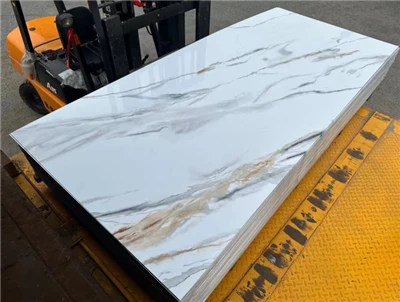
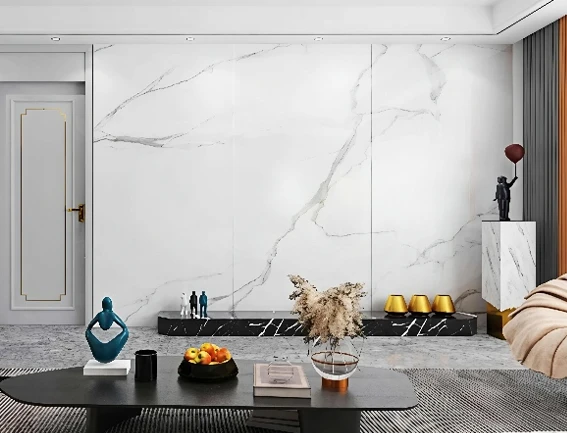
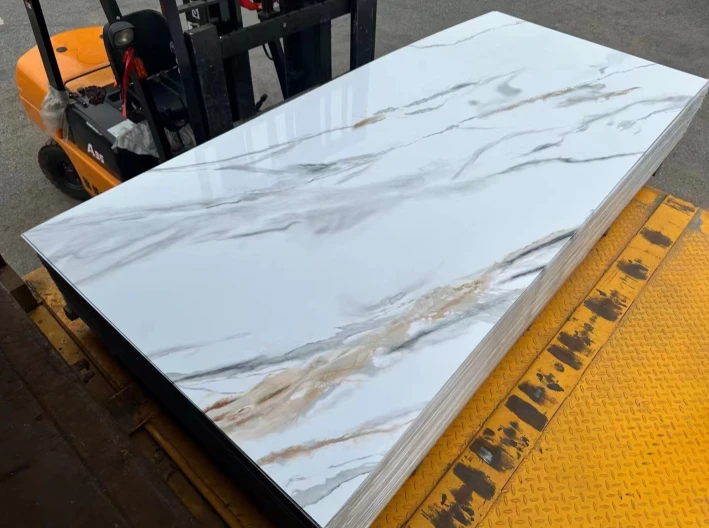
Our UV marble sheet uses a PVC and stone-powder core with a UV-cured decorative surface, for indoor wall use. What Daniel's first container needed to verify wasn't how good the sheet looked in a sample carton, but whether, once flat-palletised with corner protection, the in-transit damage profile really differed from stone. My judgement at the time was that as long as loading and packing followed our standard, the difference would hold - but it had to be proven with first-container data.
Packaging Test: Corner Protection, Pallet Design, and Container-Loading Plan
Daniel's packaging brief for the first container was clear: no crushed corners, no scuffing on the glossy face, and a pallet configuration that lets the German destination warehouse unload directly without re-palletising. I had production confirm the packing specification item by item against that brief:
- Glossy-face protection: protective film on the glossy surface to prevent scuffing;
- Corner protection: hard corner protectors covering all four corners;
- Moisture and dust protection: PE film over the whole pallet;
- Pallet type: two-way wooden pallet with blockboard surround;
- Securing method: corner protectors + metal strapping;
- Pallet height limit: 1.2 m, to prevent compression damage to lower layers;
- Loading record: staged photographs of pallet build, container floor layout, and final strapping;
- Carton weight: 40–50 kg per carton, with forklift unloading at the destination confirmed before production.
A few key actions I personally made sure landed:
- Loading photos had to be complete: Daniel asked for photographs at every stage, so I had the merchandiser document pallet build, container layout, and strapping. On stone projects it's often "your word against theirs" - with photos, it isn't;
- Carton weight confirmed before production: 40–50 kg is efficient for wholesale handling, but whether the German warehouse can unload by forklift has to be checked first. If that surfaces at the unloading dock, the first container needs repacking and the lead time is gone;
- 1.2 m pallet height limit: our product is volume-limited, not weight-limited - the height cap isn't about saving space, it's about controlling compression risk on lower layers.
MOQ and Lead Time: From Trial Container to Replenishment Rhythm
I didn't have Daniel commit to a single pattern for the first order - I structured it as a multi-SKU trial container. For a wholesaler entering the wall category for the first time, betting on one pattern carries too much risk. The terms were set as follows:
- MOQ: 1 × 20'GP for both the first container and repeat orders;
- Sheet count per 20'GP (2mm): approx. 2,200 sheets;
- Sheet count per 20'GP (3mm): approx. 1,000–1,800 sheets, depending on pallet configuration and palletised vs. floor-loaded packing;
- Main specification: 3mm indoor wall;
- Custom carton printing: deferred for the first container; available from the second order onward;
- Production lead time: 15–20 days after deposit for the first container; compressed to 10–15 days on repeat;
- Replenishment rhythm: steady at one 6–8 week cycle.
The first container was weighted toward the 3mm indoor wall specification: thick enough to hold a flat wall plane without waviness, thin enough to keep the per-square-metre freight advantage. I recommended Daniel defer custom carton printing to the second order and run the first container on standard packing - otherwise the printing stage would stretch the 15–20 day lead time.
Repeat lead time compressed to 10–15 days because the pattern selection and pallet configuration were already on file from the first container - nothing needed re-engineering between the first order and the repeat. That mattered to Daniel, because he was about to run a 6–8 week cycle: one container in production, one on the water, and fast-moving patterns held as safety stock in the German warehouse.
Sell-Through: How the Indoor Wall Category Moved at Distribution Level
Daniel positioned the product as an indoor wall category, not a stone replacement. I agreed with that positioning, and the distribution story centred on three end-use segments:
- Hotel guest-room feature walls;
- Retail fit-out walls;
- Residential renovation accent walls.
All indoor, all wall-mounted, none requiring substrate reinforcement. When the first container's sell-through data came back, Daniel's feedback matched what I expected:
- Fastest-moving specification: 1220 × 2440mm large-format marble-look patterns;
- Cutting waste: held under 3%;
- Repeat-order pattern concentration: the same 3–4 patterns;
- Inventory form: warehouse rack storage, individual sheet replacement;
- Sub-distributor willingness: broader stocking due to lower inventory risk.
Daniel also raised an advantage I hadn't written into the original proposal: the sheet format lets distributors sell from warehouse racking rather than a crated slab aisle. A stone slab that chips in storage is a write-down; a damaged UV marble sheet can be replaced individually. Once the inventory risk structure changed, sub-distributors were more willing to stock, and Daniel's resale base widened without adding warehouse footprint.
Results: Landed Cost, Damage Rate, and the Repeat-Order Decision
The first container produced no large damage claim - which was exactly what I'd committed to Daniel when taking the order.
| Result dimension | Trial outcome |
|---|---|
| In-transit damage rate | Below the stone-project baseline |
| Replacement pallet required for first container | No |
| Claim file opened | No |
| Landed cost per m² | Clearly below the stone baseline |
| Total landed and installed cost | Approx. 15%–25% of natural marble |
| Repeat-order timing | Within one replenishment cycle of first-container arrival |
| Repeat-order trigger | Predictable packaging + trial SKUs cleared + cost structure supports quoting |
The landed-cost reduction came mainly from two things:
- Container-utilisation gap: one 20'GP carries 1,000+ sheets, versus 200–300 m² of stone;
- No crating weight: wooden-crate cost and weight both eliminated.
The repeat order was placed within one replenishment cycle of the first container's arrival. Daniel didn't repeat because he'd won one big project - three things stacked up: packaging performed predictably, the trial SKUs cleared, and the landed-cost structure let him quote wall projects without carrying a large damage contingency. By the second container, he'd moved from "testing a wall alternative" to "running a replenishment SKU."
Indoor-Only Labeling: A Hard Requirement on Packaging and Sales Pages, Not a Footnote
During the trial I stressed one requirement to Daniel that couldn't be skipped: every carton and every product sales page must carry an indoor-only label.
- Why: UV marble sheet is designed for indoor walls; outdoor UV, moisture cycling, and temperature swings exceed the design envelope of the indoor formulation;
- Where: printed on the carton label and repeated on the product page - not buried in a technical data sheet;
- Who benefits: this is a specification that protects the distributor. A sheet that yellows or delaminates after outdoor installation becomes a warranty dispute; the label sets the application boundary at the point of sale;
- Status: written into the second order's packing specification and the product listing template, making it part of the standard line.
I didn't want Daniel treating this label as a footnote. It sits on the packaging and the sales page so both the distributor's team and the end buyer see the scope before installation - fewer arguments later.
FAQ: What Importers Ask Most
Q1: Does the first order have to be a full container? Can I trial a smaller quantity?
A: Our wholesale MOQ for UV marble sheet is 1 × 20'GP. The product is bulky and freight is charged per container, so a small LCL trial actually raises the unit landed cost - and it can't verify how the pallet and loading plan perform under full-container conditions. The more realistic approach for a first order is a multi-SKU trial container, not a reduced quantity.
Q2: Will 3mm sheets wave on the wall? Is the strength sufficient?
A: 3mm is the main thickness in our indoor wall series: enough to keep the wall plane flat without waviness, while preserving the per-square-metre freight advantage. But it is an indoor wall material - not for floors or load-bearing structures - and substrate flatness needs to be addressed before installation.
Q3: Is the in-transit damage rate high? What happens if something goes wrong?
A: Under the standard configuration of flat pallets, hard corner protectors, PE film, and metal strapping, the first container in this case came in below the buyer's original stone-project baseline - no replacement pallet was required and no claim file was opened. Staged loading photographs are kept as a standard record, so any dispute has documentation behind it.
Q4: Can carton printing and branding be customised?
A: Yes, but I recommend starting from the second order. The first container runs on standard packing with production at 15–20 days after deposit; adding custom printing requires extra buffer, and moving it to the repeat order keeps the first-container timeline intact.
Q5: Why must the packaging and sales page carry an "indoor-only" label?
A: It's a product application boundary, not marketing language. UV marble sheet is formulated for indoor walls; outdoor UV, moisture cycling, and temperature swings exceed the design conditions and can cause yellowing or delamination. Printing the label on the carton and product page sets the application boundary at the point of sale, protecting the distributor from later warranty disputes.
Summary
The point of this case isn't that "UV marble sheet is cheaper than natural stone." It's how one import wholesaler used a single trial container to clear three uncertainties in a new wall category - whether the packaging survives full-container transit, whether the landed-cost structure supports quoting, and whether sell-through clears the trial SKUs. A few takeaways are directly reusable:
- Verify packaging on the first container before scaling: flat pallets, hard corner protectors, PE film, metal strapping, a 1.2 m height limit, and staged loading photos are the direct reason this case came in below the stone baseline on damage;
- The landed-cost gap comes from the loading method: one 20'GP carries 1,000+ 3mm sheets versus 200–300 m² of natural stone - freight is spread by volume, not weight, so the cost structure changes before a single sheet is sold;
- A multi-SKU trial container is safer than betting on one pattern: the first container validates sell-through, and the repeat order concentrates on the 3–4 patterns that move - lower inventory risk;
- Lead-time compression comes from first-container documentation: once patterns and pallet configuration are locked on the first container, repeats compress to 10–15 days and support a 6–8 week replenishment cycle;
- The indoor-only label is a specification, not a footnote: printed on the carton label and product page, it sets the application boundary at the point of sale and protects the distributor;
- A repeat order is triggered by three things stacking up: predictable packaging performance, trial SKUs that clear, and a cost structure that lets the buyer quote without a large damage contingency.
For import wholesalers evaluating an indoor wall category, what's replicable here is the order of verification: use one container to confirm packaging and loading first, then use sell-through data to decide the repeat-order structure - rather than pressing volume from the start using stone-purchasing logic.
Contact
If you're evaluating indoor UV marble sheets as a wall category, or want the packaging configuration, pallet plan, and loading data behind this case, you can reach us directly:
- Contact: Emily Johnson (Manager)
- Company: Haining Longtime Industry Co., Ltd.
- Email: ltfriend01@jxlongtime.com.cn
- WhatsApp / Phone: +86 173 7761 1682
- Website: https://www.longyuanpanels.com/
- Address: No.10-1 Lianhong Road, Yuanhua Town, Haining City, Zhejiang Province, China
We've manufactured PVC wall panels and UV marble sheets since 2005, with production across Haining, Guangxi, Indonesia, and Vietnam, and can support importers' target markets with matched packaging, pallet, and indoor-only labeling configurations.
This case study was compiled by Haining Longtime Industry Co., Ltd. from the first-container trial of a German import wholesaler (Daniel Fischer, name changed), for B2B import buyers evaluating indoor UV marble sheet as a wall category.