For residents living in hurricane alley, choosing a wall material is never an aesthetic question - it's a matter of survival.
In September 2025, Category 3 Hurricane Ida made landfall near Tampa Bay, Florida. Storm surge flooded countless coastal homes for over two days. When the waters receded, most homes showed the same tragedy: drywall crumbling like soaked crackers, paint blistering with mold, wood wainscoting warped beyond repair. But amid the wreckage, one newly renovated vacation villa stood out - its walls were perfectly intact, restored to their original state with nothing more than a freshwater rinse.
The villa's owner, retired dentist Michael Thompson, sent a thank-you email to Haining Longtime on the third day after the disaster. The subject line read simply: "Your wall panels saved my house - and my insurance claim record."
This is a story about water, and a case study of how SPC wall panels have redefined "waterproof" in extreme humidity.


I. A Nightmare of Repeated Soaking: Why Michael Was Obsessed with Waterproofing
This wasn't Michael's first encounter with water damage. His villa, built in 1989, has a typical wood-frame structure with an elevated crawlspace, but the walls have long suffered from sea salt spray and seasonal downpours. Over the past decade, he has had to repair or replace interior walls almost every two years.
- 2018: After a heavy rain, the drywall under the guest bedroom window absorbed moisture and expanded; the paint peeled like dead skin.
- 2021: A slight leak from the air conditioner condensate line, hidden inside the wall, went unnoticed. The entire wall grew black mold behind the wallpaper, leading to health complaints from tenants.
- Early 2024: A small storm surge pushed about 10 cm of seawater into the living room. Though the water was quickly removed, the junction between the laminate flooring's baseboard and the adjacent latex-painted wall left a permanent gray-blue mold ring.
Michael told his designer bluntly: "I don't care if the wall feels cold or warm to the touch. I care that when the water goes away, it can be treated like a piece of dirty furniture, not a pile of construction waste waiting to be torn out."
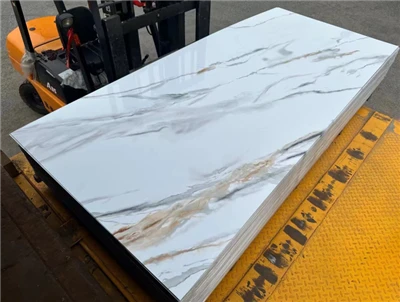
That statement led the design team to Haining Longtime, and they specified our 4mm stone grain series SPC wall panels as the wall solution for all ground-floor spaces.
II. Deep Dive into Waterproof Performance: Not Moisture-Resistant, But Water-Repellent
Most consumers are easily confused by the term "waterproof." In building material science, moisture resistance and true non-absorption are two completely different physical characteristics. The waterproof logic of Haining Longtime SPC wall panels is based on a simple principle: the substrate has nothing to absorb, and the surface has no pores to penetrate.
The core of the panel is made from natural limestone powder (over 65% calcium carbonate), high-molecular PVC resin, and stabilizers, fused under high temperature. Its microstructure is extremely dense, with no wood fibers or gypsum pores. This gives it a highly convincing technical parameter:
- 24-hour water absorption rate (ASTM D570): <0.08%
For comparison, ordinary MDF has a 24-hour water absorption rate usually above 15%, and natural wood is even higher. This means that even if our SPC wall panels is completely soaked in water for a whole day, its weight gain is negligible, and its dimensions show no measurable expansion.
Before installation, Michael and his crew did a simple but impressive on-site experiment. They put a piece of cut SPC panel scrap, a piece of fiber cement board, and a small piece of pine wainscoting into a clear storage box filled with water, held down with a brick. After 48 hours:
- The pine piece was visibly warped, and the water had turned cloudy and yellow.
- The fiber cement board showed slight edge swelling and delamination.
- The Haining Longtime SPC sample, when taken out and wiped dry with a paper towel, felt as hard as new. Caliper measurements showed no change in thickness or width. Most surprisingly, when Michael snapped the sample in half to look at the cross-section, the interior was still dry - water molecules had not penetrated the substrate.
"This isn't like wood. It's like stone, but lighter and warmer to the touch." That's what he wrote in his experiment log.
III. Hurricane Battle: On-Scene Report After 48 Hours of Soaking
When Hurricane Ida passed, storm surge entered through the front door and the bottom of the patio sliding door. The entire living room and hallway floor were submerged, with a clear mud line on the walls about 16 cm high.
After the flood receded, Michael's neighbors faced drywall that had to be torn out, soaked through, and insulation that was already black with mold. Michael's SPC panels showed their true value:
- Zero expansion and buckling: The click-lock joints remained flat and tight. Traditional wood expands with water absorption, causing joints to pop open, but the SPC substrate's non-absorbent nature kept the entire wall dimensionally stable.
- Mud wiped off easily: The mixture of seawater and mud stuck to the UV wear layer and could not penetrate. A housekeeper using a wet mop and mild cleaner restored the wall's original appearance.
- No mold after effects: Because no moisture remained inside the wall, even with FEMA's recommended drying period of only three days, there was no musty smell behind the walls. Air quality readings were unchanged from before the disaster.
- Protection of the underlying structure: The panels themselves acted as a perfect physical waterproof barrier, protecting the wood studs behind them from moisture, saving Michael at least $15,000 in wood structure repair costs.


IV. Product Waterproof Performance Comparison Table
For professional clients, here is a comparison of Haining Longtime SPC wall panels with several common wall materials used in North American coastal homes, based on key waterproof indicators:
|
Performance Indicator |
Haining Longtime SPC |
Fiber Cement Board |
MR Gypsum Board |
Solid Wood Wainscoting |
|
24h Water Absorption Rate |
<0.1% |
8%-12% |
5%-10% |
>20% |
|
Expansion Rate After Soaking |
0.00% |
0.15%-0.25% |
0.08%-0.15% |
0.30%-1.20% (plus warping) |
|
Surface Waterproof Mechanism |
UV cross-linked dense layer, zero penetration |
Requires waterproof coating; performance depends on coating integrity |
Paper-faced; once damaged, absorbs water |
Depends entirely on paint film; if paint cracks, it fails |
|
Mold Resistance Rating |
Class 0 (no mold growth) |
Class 2 (minor, depends on coating) |
Class 1 (treated, but cut edges vulnerable) |
Class 0-1 (depends on paint, and substrate has nutrients) |
|
Wet Area Installation (no additional membrane) |
Feasible, with proper sealing at edges |
Not recommended; must use waterproof membrane |
Not recommended, dry areas only |
Not recommended |
|
Post-Flood Cleaning Method |
Rinse with fresh water, wipe with disinfectant |
Surface can be cleaned; joints may need redoing |
Must replace |
Must replace |
|
Salt Spray Resistance |
Excellent; substrate is chemically inert |
Moderate; surface coating may be eroded |
Poor; metal edges corrode easily |
Moderate; paint requires frequent maintenance |

V. Frequently Asked Questions About Haining Longtime SPC Wall Panel Waterproofing
Based on customer inquiries from around the world, here are common questions and our engineering answers:
Q1: Since SPC panels are 100% waterproof, why do you still need to caulk the edges during installation?
A: The panel itself does not absorb water, but water can enter through very small physical gaps and get behind the wall. Using neutral mildew-resistant sealant around bathrooms and shower areas is like putting a raincoat on the wall and buttoning it up - the goal is to completely block the physical path of water, not because the panel is afraid of water.
Q2: If I pour a kettle of boiling water directly on an SPC panel, will it warp or get damaged?
A: No. The Vicat softening point of the SPC substrate is usually above 80°C; momentary contact with boiling water will not soften or discolor the panel. However, prolonged concentrated heat (e.g., next to a stove without a backsplash) may accelerate aging of the UV layer. We recommend using a splashback in cooking areas.
Q3: After being soaked in floodwater and dried, will the click-lock strength of SPC panels decrease?
A: No. The locking mechanism is made of the same material as the substrate - it doesn't absorb water, so there is no hydrolysis or loss of strength. We did a lab cycle test: 24 hours of soaking followed by drying at 60°C, repeated 20 times. The tensile strength of the lock remained above 95%.
Q4: My basement has constant moisture and water vapor rising from the floor. Can SPC panels be installed directly against the wall?
A: This is one of the ideal applications for SPC panels. Unlike wood, they will not wick moisture from the bottom and can be installed directly on basement walls. However, if there is active hydrostatic pressure or water seepage from the floor, that should be fixed first - the panels themselves are not the problem.
Q5: Can they be used outdoors in rainy areas, like on an open balcony wall?
A: We do not recommend using interior SPC panels directly in fully exposed outdoor environments with constant sun and rain, because UV radiation will slowly age the surface layer, and extreme freeze-thaw cycles may stress the locking system. But for semi-outdoor spaces with a roof (e.g., corridors, poolside bar areas), they perform excellently.

VI.Trust and Certifications: Haining Longtime Waterproof Wall Panels
We know that in the building materials industry, independent third-party test data speaks louder than promises. Here are the key international certifications held by Haining Longtime SPC panels, which gave Michael the confidence to choose us:


VII.Michael's Post-Disaster Summary
During a post-disaster follow-up visit, Michael was planning to replace the remaining two bedrooms with the same wall panels. He told our project manager over the phone:
"A lot of people think a beach house should have tile, but they forget that salt water vapor corrodes metal and makes cement brittle. I used to be afraid of every next hurricane. But now I know that some walls cannot stop water - and some walls themselves live in water and never change. Your panels finally mean I don't have to neurotically feel the baseboards every time it rains."
VIII. Conclusion
Floodwater, salt spray, condensation, sudden leaks - water always finds the weakest point and then destroys the comfort and safety of an entire space. Haining Longtime SPC wall panels do not resist water; they refuse to react with it at a physical level. This is not just a wall panel; it is a wall protection system that stands up to soaking.
Is your project looking for a truly waterproof wall solution?
Contact us now to get the same waterproof comparison sample box that Michael used, containing our SPC panel sample, a fiber cement board sample, a solid wood sample, and a simple soak test guide. You can conduct this "trial by water" right in your office and see for yourself what true zero absorption means.
- Website:https://www.longyuanpanels.com/
- Email:ltfriend01@jxlongtime.com.cn
- WhatsApp:+86 173 7761 1682
- Phone:0086 173 7761 1682