As someone who has worked in the WPC building materials industry for more than ten years, I encounter the same question at the beginning of almost every project: Are outdoor WPC wall panels actually scratch-resistant? This concern is very reasonable. Outdoor walls face sun and rain, branches, pets, accidental contact with garden tools, and all kinds of friction during installation and daily use. So I want to answer this question directly from a technical and project-experience perspective, rather than with marketing language.
1. Short Answer
Yes. Qualified, correctly manufactured WPC outdoor wall panels-especially co-extruded products with a complete protective layer-are scratch-resistant under normal outdoor use conditions.
But "scratch-resistant" does not mean "never scratched." Whether a wall panel still looks good after 15 years or shows obvious wear in less than two years depends largely on how it is made.
2. Why Co-Extrusion Determines Scratch Resistance
Early first-generation WPC products, often called "uncapped" or "first-generation wood-plastic composite," had their wood-plastic core directly exposed on the surface. Because wood fibers were right at the surface, they were as prone to fading, staining, and scratching as natural wood. This is why even today some designers and buyers remain skeptical of WPC.
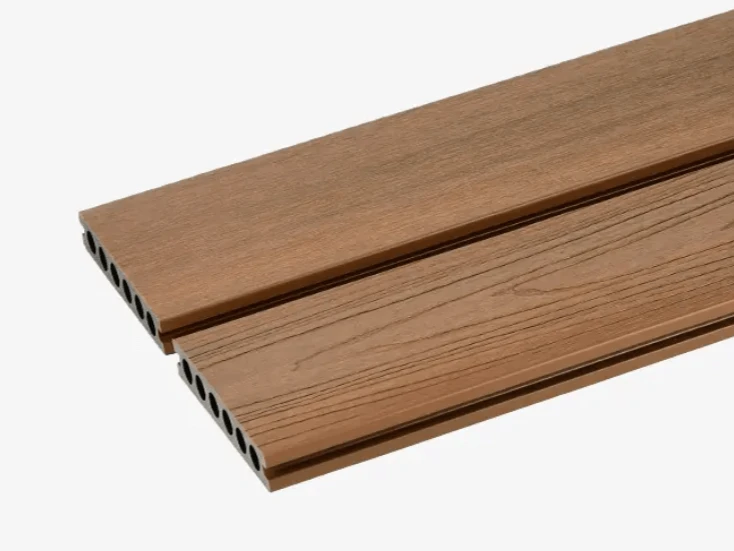
The real change came with co-extrusion technology. During co-extrusion, a polymer protective layer is fused with the wood-plastic core during the extrusion process. It is not applied later, nor is it simply sprayed on. It forms a molecular-level bond on all four sides of the profile. This protective shell acts like a "hard armor" on the outside of the panel. When a branch scrapes across it, a ladder shifts, or a chair hits it, the protective layer absorbs and distributes the force first, instead of allowing the force to reach the wood-fiber core inside.
Test data show a clear difference. Co-extruded WPC wall panels typically offer more than five times the wear and scratch resistance of traditional uncapped WPC. In laboratory testing using the FLTM BO 162-01 standard, where a 1 mm needle is drawn across the surface under gradually increasing pressure, high-quality co-extruded panels show no obvious scratches at 20N, while traditional composite panels may show marks at around 8N.
3. What the Tests Actually Measure
Many customers get confused by marketing terminology. I usually recommend focusing on three types of tests.
1. Taber Abrasion Test
This is a common method for evaluating surface wear resistance. A rotating abrasive wheel rubs against the panel surface under a set load, and material loss is measured after a certain number of cycles. The lower the loss, the better the wear and scratch resistance. High-quality co-extruded WPC wall panels can usually keep material loss at around 20–25 mg after 1,000 cycles under a 750 g load, while uncapped products may reach more than 80 mg.
2. Pencil Hardness Test
This test uses pencils of different hardness to draw across the surface, assessing the surface's resistance to indentation and scratching. The higher the hardness rating, the less likely the surface is to be marked by hard objects.
3. Coin/Screwdriver Field Test
This is the simple test I most recommend buyers perform before placing a bulk order. Use a coin or flathead screwdriver to scratch the sample surface with moderate pressure. A good co-extruded panel will usually show only very slight marks, or no obvious marks at all. A poor-quality product will scratch immediately, indicating that its wear layer is very thin or that it does not have a true co-extruded protective layer.
4. When Do WPC Panels Scratch-and How Can You Prevent It?
I must be honest: a WPC surface is not armored steel. Although wood-grain co-extruded wall panels are scratch-resistant, they can still be marked under certain conditions.
Common risks include:
- Repeated friction from ladders, scaffolding, and metal tools during installation;
- Heavy objects being dragged directly across the wall when furniture or carts are moved;
- Cutting materials directly on the panel surface;
- Strong scratching by sharp metal objects.
Practical advice is simple: During installation, add protective film or temporary protection boards wherever ladders, scaffolding, and tools may contact the wall. Most scratches actually happen in the final 10% of a project, when workers are rushing to finish and pay less attention to protection.
In daily use, the co-extruded protective layer can handle common contact from branches, pets, bicycles, garden hoses, and similar objects. Truly high-quality co-extruded products provide 360° protection-not only on the front face, but also on the sides, grooves, and edges-rather than protecting only the visible front surface.
If minor scratches do occur, one advantage of a same-color core is that some shallow scratches can be repaired by light sanding, without the obvious color loss that painted or stained wood wall panels show. This is also an important advantage of WPC over traditional wooden exterior cladding.
5. Two Project Case Studies
The following cases come from our actual project communication records. Client names have been omitted for privacy reasons.
Case Study 1: Private Residential Garden Room Project in the UK
A private homeowner in the UK commissioned us to supply outdoor WPC wall panels for a garden room renovation. The area was approximately 125 m², used for exterior wall decoration on an existing garden structure.
The project faced a typical UK residential environment: year-round rain, humidity, and large temperature differences. The homeowner especially wanted to avoid the repeated painting, sanding, and maintenance required by traditional wooden wall panels.
What we supplied:
160 mm × 24 mm dark grey co-extruded WPC wall panels with a vertical striped surface.
Actual scratch-resistance performance:
Installation was completed in October 2025. Since then, the panels have experienced normal household garden activities, including hedge trimming, moving furniture on the adjacent terrace, and children playing outdoors. The co-extruded protective layer showed no obvious scratches or scuff marks. The homeowner reported that daily cleaning requires only rinsing with a garden hose, occasionally with mild soap. No protective coating, repainting, or scratch repair is needed.
Conclusion:
For residential outdoor projects with normal use intensity, as long as WPC wall panels with a true co-extruded protective layer are selected, scratch resistance can fully meet the requirements. The key is to confirm that the product is not merely surface-coated, but has a complete co-extruded structure.
Case Study 2: Lakeside Pavilion Project in Florida, USA
A client in Orlando, USA, customized an outdoor lakeside pavilion for entertainment and leisure. The project is located directly beside a lake, so it faces multiple challenges at the same time: high humidity, high temperatures, lake moisture, and frequent use by guests.
What we supplied:
Teak-colored co-extruded WPC wall panels, used for column cladding and the outdoor kitchen bar backsplash area, with a vertical wood-grain orientation to match the pavilion's open structure.
Actual scratch-resistance performance:
This pavilion is a high-frequency entertainment space. Serving carts move along the walls, chairs are frequently pulled in and out, and the lakeside environment means wind-blown debris and sand are a daily reality. After several months of Florida sunlight and outdoor use, the client reported that the panels still looked "as good as new" in color, with no obvious surface damage.
Conclusion:
In outdoor commercial or semi-commercial environments where scratching is likely, WPC wall panels can perform reliably as long as the right material is selected. The ASA/PVC co-extruded surface used in this project provides both UV resistance and a harder surface that resists mechanical contact in an active space.
6. Three Questions Buyers and Designers Should Ask
If you are evaluating WPC wall panels for an outdoor project, I recommend asking suppliers three questions:
- Does this wall panel have a complete 360° co-extruded protective layer? If the supplier cannot confirm this, it is likely a surface-treated product, and long-term scratch resistance will decline.
- Can you provide wear test data? Do not rely only on marketing claims; look at actual test results. The material loss value per 1,000 cycles in the Taber Abrasion Test is one of the most valuable data points.
- What does the warranty cover for surface performance? A quality manufacturer will provide a clear warranty for surface performance in outdoor use, typically 10–15 years for outdoor applications.
Conclusion
At Haining Longtime Industry Co., Ltd., we have been manufacturing WPC products since 2005. We have witnessed the industry evolve from problematic first-generation wood-plastic composites to today's co-extruded systems that truly deliver low-maintenance, scratch-resistant outdoor performance.
So the question is not "Can WPC resist scratches?" but "Have you selected the right grade of WPC for your outdoor project?"