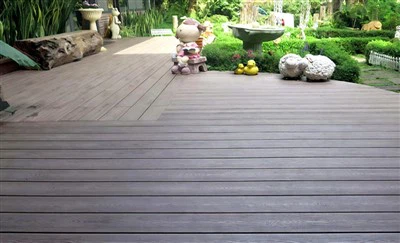
Over the past ten years in WPC wall panels export, I have had no fewer than fifty customers ask me the same question: "When your panels reach the Middle East / Northern Europe / Southeast Asia, will they bow up in summer? Will they crack in winter?" Frankly, it is a very good question-because it points directly to the most central and most easily misunderstood performance indicator in outdoor WPC applications: dimensional stability.
Today, I want to explain this thoroughly as a sales manager who has visited hundreds of job sites and also works with laboratories year-round.
1. What Exactly Is Dimensional Stability?
Simply put, dimensional stability refers to a material's ability to maintain its original shape and dimensions when environmental factors such as temperature and humidity change. For outdoor WPC wall panels, it specifically manifests in three dimensions: the rate of change in length, the rate of change in width, and the amount of expansion in thickness.
The industry's standard test method is to place samples in a high-temperature, high-humidity environment at 70°C / 95% RH for 48 hours, then accurately measure dimensional changes, with ASTM D7031 as the reference standard. For qualified outdoor-grade WPC wall panels, this rate of change is usually required to be controlled within 0.5%.
But these are only laboratory numbers. The real test is on the job site.
2. Key Insight: Thermal Expansion ≠ Moisture Expansion
This is the biggest knowledge gap I have found when communicating with customers. Many people simply attribute WPC deformation to "it got damp," but the reality is much more complex.
Wood mainly expands through moisture absorption-wood swells in the width direction after absorbing water and shrinks when it dries. WPC is different. Because wood fibers are encapsulated by thermoplastic polymers (HDPE or PVC), water can hardly penetrate, so WPC's moisture expansion is greatly suppressed. What really makes WPC "move" outdoors is thermal expansion-when the temperature rises, the polymer matrix elongates linearly along the length.
How big is the difference between these two expansion mechanisms? Look at this data comparison:
|
Material |
Linear thermal expansion coefficient (×10⁻⁵/°C) |
|
Wood (parallel to grain) |
0.5 |
|
WPC (typical) |
3.5 |
|
Aluminum alloy |
2.3 |
|
PVC |
5.0–7.0 |
WPC's thermal expansion coefficient is about 7 times that of wood and close to that of aluminum alloy. This means that when designing an outdoor WPC wall panels system, you cannot treat it like wood; you should refer more to the design logic of metal curtain walls.
The co-extruded WPC wall panels exported by our company have a linear thermal expansion coefficient controlled at 0.025 mm/m·°C, about half that of traditional PVC exterior wall panels (0.05 mm/m·°C). Taking a 4-meter-long wall as an example, over a temperature difference from -10°C to 40°C, the total expansion is only 5 mm, which can be fully accommodated by standard 8–10 mm installation gaps.
3. Two Real Cases: Dimensional Stability in Actual Practice
Case 1: Rotterdam Port Hotel - 4.2 m Continuous Boards, Tested from -10°C to 35°C
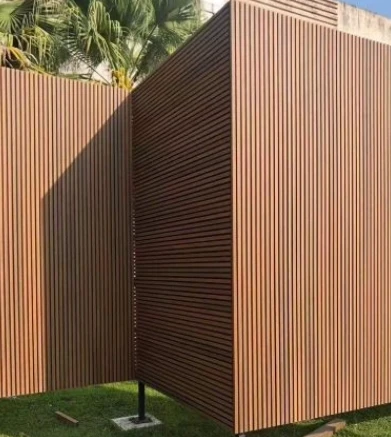
In early 2026, the Dutch architecture firm VdK Architekten approached us to find materials for the façade of a hotel in the Rotterdam port area. The project is only a few hundred meters from the sea. The owner initially specified ThermoWood (heat-treated wood), but the firm had previously used ThermoWood on a coastal project, and within less than five years it showed surface graying, local cracking, and mold on the sea-facing side.
The owner's requirement was very clear: "We want the texture and appearance of wood, but we don't want to repaint it every year."
The core challenge of this project was size. The architect required 4.2 m continuous boards with no horizontal support in the middle. This length is a severe test for the dimensional stability of any material-ordinary WPC or PVC boards bow up in the middle under summer heat, recover after shrinking in winter, and after repeated cycles the entire wall takes on a wavy appearance. Rotterdam's annual temperature difference is about -10°C to +35°C. Although not extreme, it is enough to expose poor-quality boards for what they are.
We provided co-extruded WPC wall panels samples, along with accelerated aging test reports simulating a marine climate. After the customer conducted its own 72-hour saltwater immersion test, the feedback was: "The results exceeded expectations." The final comparison data for the project is as follows:
|
Comparison item |
Co-extruded WPC |
ThermoWood |
PVC foam board |
|
24 h water absorption |
≤0.5% |
>12% |
≤0.1% |
|
Flexural strength (MOR) |
≥28 MPa |
≈22 MPa |
≈10 MPa |
|
UV aging 1500 h |
Gray scale 4–5 |
Grade 2–3, graying within 6 months |
Grade 3–4, uneven fading |
|
Maintenance requirement |
No maintenance |
Annual oiling |
Prone to dust accumulation; frequent cleaning required |
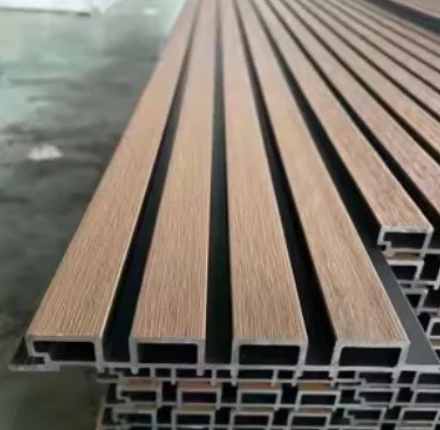
The key technical support lies in the co-extruded structure: the core layer is a WPC composite of wood fiber + HDPE, and the outer layer is a fully encapsulating co-extruded protective layer. This outer layer not only blocks moisture intrusion but also provides UV protection through an ASA or PVC formulation, so that during thermal expansion the panel will not deform faster because of surface aging. Installation uses a hidden clip system: the dovetail grooves on the back of the panel engage with fixed clips and lock by pressing, achieving the appearance requirement of no visible screws while allowing the panel to expand and contract freely within the clips.
To date, the project has been in operation for more than half a year and has gone through a complete temperature cycle in Rotterdam from winter to summer, with no reports of panel bowing or joint cracking.
Case 2: Bali Boutique Hotel Pool Area - 14 Months at 85% Humidity
If Rotterdam's challenge was "heat," the test in the Bali project was "moisture."
In March 2025, a boutique hotel in Bali renovated its pool area. The original hardwood wall panels in this area faced serious problems in the tropical climate: year-round humidity of 80%–88% caused the wood to repeatedly expand and contract, requiring sanding and resealing every six months, with high maintenance costs.
The hotel needed a wall panel material whose dimensions would not change under continuously high humidity. We supplied ASA/PVC co-extruded WPC wall panels. One technical detail needs explanation here: there is an essential difference in moisture absorption behavior between PVC-based WPC and HDPE-based WPC. PVC itself hardly absorbs water; using it as the polymer matrix suppresses WPC's moisture expansion to an extremely low level. The ASA surface layer, meanwhile, is responsible for resisting the intense tropical UV radiation.
Tracking data 14 months after installation:
- Mold: 0. No mold growth on any panel surface.
- Expansion/deformation: 0. No visible change in panel dimensions or shape.
- Color difference: 0. No fading or discoloration of the ASA surface layer.
The hotel maintenance manager's exact feedback was: "Fourteen months, no mold, no expansion, no fading. The previous hardwood had to be sanded and sealed every six months; now there is nothing to worry about at all."
4. What Have We Learned from These Two Cases?
Although the climate conditions of these two projects are completely different, the principles they reveal are consistent:
First, the dimensional stability of outdoor WPC depends on the "base polymer," not the "wood fiber content." PVC-based WPC is far superior to HDPE-based WPC in moisture expansion; the latter's performance in extremely hot and humid environments needs to be compensated for by stricter surface-layer protection.
Second, thermal expansion is the main driving force of deformation in outdoor applications. Regardless of humidity level, temperature changes cause WPC to expand and contract linearly along its length. Leaving sufficient expansion gaps during installation-5–8 mm is recommended for outdoor use-is the most basic and most important requirement. For the 4.2 m board length in the Rotterdam project, without reasonable gap design, the expansion under summer heat would be enough to make joints butt tight or even bow.
Third, the co-extruded surface layer is not "decoration"; it is part of dimensional stability. It blocks moisture, resists UV aging, and prevents the surface layer from degrading before the core layer and causing uneven stress that leads to deformation.
Fourth, the design of the installation system determines whether the material's performance can truly be brought into play. Hidden clip systems allow panels to slide freely between fixed points and are the standard practice for long-board outdoor applications. Using self-tapping screws to penetrate and fix the panel directly is equivalent to locking all thermal expansion stress inside the panel; deformation is only a matter of time.
If you are planning an outdoor WPC wall panels project-whether in the Middle East's high heat and intense sun, Northern Europe's freeze-thaw cycles, or Southeast Asia's continuously high humidity-you are welcome to contact us. The team at Haining Longtime Industry Co., Ltd. can provide installation recommendations, including expansion gap calculations, based on your specific climate conditions and board length requirements.
Emily Johnson
Senior Sales Manager | Haining Longtime Industry Co., Ltd.