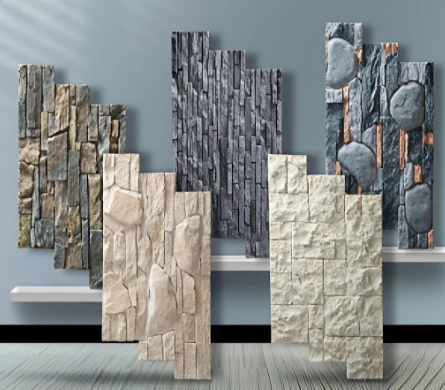
After more than a decade in the building materials industry, I increasingly hear the same question-not "Does PU Fortress Stone look like real stone?" but "How much faster is it to install?"
That question gets to the heart of the matter. No one denies the aesthetic value of natural stone, but under today's project schedules, installation time is no longer a "bonus"-it is a make-or-break factor. Every week a project is delayed, scaffolding rental, labor, idle equipment, and lost revenue from delayed openings all add up. So in this article, I am not going to talk about subjective indicators such as "texture" or "premium feel." I will focus on the hard numbers: how large the installation-time gap is between PU Fortress Stone and natural stone, where that gap comes from, and what it means in real projects.


1. Core Data: Installation Rates Are Not on the Same Order of Magnitude
Let's start with the most direct comparison.
Installing natural stone is essentially a masonry process. It requires skilled stonemasons, wet cutting, mortar mixing, and leveling and aligning each piece, which places strict demands on worker experience and physical endurance. The industry-average installation rate is roughly 1–1.5 m² per person per hour. A skilled crew can typically complete only a few square meters per day.
PU Fortress Stone is designed according to a completely different logic. From the outset, it was not intended to "imitate how stone is installed," but to escape the way stone is installed. The product comes with a built-in nailing flange and interlocking edge system and supports both adhesive-fixing and mechanical-fixing methods. Ordinary carpenters or exterior cladding workers can get started after a short training session. The average installation rate reaches 4–5 m² per person per hour, 3–4 times that of natural stone.
For a single worker, this multiple may be just an efficiency indicator. But at the project scale, it is amplified in weeks.
Table 1: Key Parameters: PU Fortress Stone vs. Natural Stone
| Comparison Dimension | Natural Stone | PU Fortress Stone | Impact on Installation Time |
|---|---|---|---|
| Average installation rate | 1–1.5 m²/person/hour | 4–5 m²/person/hour | On-site installation 3–4 times faster |
| Weight per panel/system | Approx. 50–80 kg/m² | Approx. 4.5–5 kg/m² | Usually eliminates structural reinforcement and the associated verification and reinforcement cycle |
| Installer requirements | Skilled stonemasons | Ordinary carpenters/exterior cladding workers; half-day training | Not constrained by shortages of skilled masonry workers |
| Material processing lead time | Approx. 30 days (material selection, cutting, surface treatment, transportation) | Standard textures kept in stock; approx. 7 days to site | Material waiting time greatly reduced |
| Fixing and curing | Mortar masonry; curing required; work may stop in rain | Structural adhesive + screws; 24-hour curing; workable in rain | Curing and weather-related downtime significantly reduced |
| Old-wall renovation | Usually requires removal of old stone and reinforcement | Can be directly overlaid; no removal required | Eliminates removal and substrate preparation |
2. What Really Creates the Gap Is Not "Faster Application," but "No Waiting"
If you look only at installation rates, you will underestimate PU Fortress Stone's time advantage. The reason natural stone projects take so long is that multiple time bottlenecks exist in parallel, and PU Fortress Stone eliminates most of them.
First, no waiting for reinforcement. Natural stone typically weighs 50–80 kg/m². For old-wall renovations or lightweight wall projects, structural verification and reinforcement are often required first-this alone consumed 25 days in the Hangzhou project. PU Fortress Stone weighs only about 5 kg/m², so ordinary walls can carry it directly, and the reinforcement stage is skipped entirely.
Second, no waiting for stone processing and transportation. For natural stone, 30 days is normal from quarry selection, cutting, and surface treatment to transportation, and any delay in any step is transmitted to the site. PU Fortress Stone is mold-produced, with standard textures and colors kept in stock. In the Hangzhou project, it took only 7 days from order to material arrival.
Third, no waiting for skilled stonemasons. This is not a minor issue. The global construction industry generally faces a shortage of skilled masonry workers, and PU Fortress Stone's installation threshold is low enough that "half a day of training is enough to get started," meaning projects are no longer held up by a small number of trades.
Fourth, no waiting for drying. Cement mortar requires curing time and may stop work in rain. PU Fortress Stone is fixed with structural adhesive and screws; the adhesive cures in 24 hours, is unaffected by weather, and work can continue in rain.
Table 2: Comparison of Total Project Time Composition (Example: Old-Wall Exterior Renovation)
| Time Stage | Natural Stone Solution | PU Fortress Stone Solution | Time Difference |
|---|---|---|---|
| Structural inspection and reinforcement plan | Approx. 17 days | Usually omitted or greatly simplified | Saves approx. 17 days |
| Removal of old stone | Approx. 10 days | Direct overlay, 0 days | Saves approx. 10 days |
| Wall reinforcement and curing | Approx. 15 days | No reinforcement, 0 days | Saves approx. 15 days |
| Material processing and delivery | Approx. 30 days | Approx. 7 days | Saves approx. 23 days |
| On-site installation | Approx. 20 days | Approx. 10 days | Saves approx. 10 days |
| Adhesive/mortar curing | Several days, weather-dependent | 24 hours | Saves several days |
| Total | Approx. 90 days | Approx. 17 days | Reduced by approx. 73 days |
3. Two Real Projects: The Time Math Laid Out
Case 1: Exterior Facade Renovation of Qingshan Lake Villa Community, Hangzhou (850 m², 18 Villas)
The background of this project is very representative. The community was built in 2010, and the original exterior walls used natural mushroom stone. After more than a decade, problems appeared: water seepage, moss, cracking, and detachment. During the plum rain season, interior walls became moldy, and property maintenance work orders kept coming. Yet the property company hesitated to start work for only one reason: the overall duration of the natural stone solution was close to three months. Scaffolding would stand in the community for three months, continuously disrupting the daily lives of 180 households. The pressure from complaints and dissatisfaction far exceeded budget pressure.
If constructed with natural stone, the timeline would be: structural inspection 7 days → reinforcement plan design 10 days → removal of old stone 10 days → wall reinforcement construction 15 days → waiting for new stone processing 30 days → mechanical fixing installation 20 days, totaling about 90 days.
After comparing seven alternative solutions, the property company ultimately chose Haining Longtime's PU Stone H004 mushroom stone series. The actual timeline was: structural reinforcement 0 days (no reinforcement), old stone removal 0 days (direct overlay), material delivery 7 days, on-site installation 10 days (25 m²/person/day), curing 0 days (adhesive usable in 24 hours). The total duration was about 17 days, compressed by 73 days-from "three months" to "less than three weeks."
Table 3: Timeline Comparison for Qingshan Lake Villa Community, Hangzhou
| Construction Stage | Natural Stone Solution | PU Fortress Stone Solution |
|---|---|---|
| Structural inspection and reinforcement plan | 7 days + 10 days | Simplified |
| Old stone removal | 10 days | 0 days (direct overlay) |
| Wall reinforcement | 15 days | 0 days (no reinforcement) |
| Material processing and delivery | 30 days | 7 days |
| On-site installation | 20 days | 10 days |
| Curing | Several days | 24 hours |
| Total duration | Approx. 90 days | Approx. 17 days |
The key point here is not simply that "installation was faster," but that the sequentially waiting stages in the entire project chain were greatly streamlined. The old wall surface did not need to be removed-new panels were directly overlaid; there was no waiting for reinforcement curing; materials were pre-numbered by building and wall surface and installed immediately upon arrival. Only when these three factors are combined does the result of "three months to three weeks" emerge.
Case 2: Arc'teryx China Flagship Store Facade Upgrade (1,280 m², Delivered in 28 Days)
Commercial projects are even more time-sensitive. The Arc'teryx flagship store facade project had only 28 days from contract signing to opening, including 15 days of production and 13 days of installation. During material selection, the project owner set a hard constraint: the original building facade's load capacity was only 30 kg/m², while natural stone is about 80 kg/m², and a mechanical fixing system would also require additional framing and anchorage-structurally infeasible.
PU Rugged Rock Panel weighs 4.5 kg/m² per panel, about 1/18 that of natural stone, and uses a frameless clip plus structural adhesive dual-fixing system. On-site data: a single worker can install 25 m² per day, about 3 times faster than natural stone mechanical fixing. The general contractor's project manager said at acceptance: "The work that would have taken 20 days with natural stone was completed in 10 days."
This case illustrates a point beyond "installation speed": in existing-building renovation and commercial space projects, natural stone may simply not be time-feasible-not because it is slow, but because structural conditions and project windows fundamentally do not allow it. The value of PU Fortress Stone is that it turns such projects from "impossible" into "possible."
4. An Easily Overlooked Variable: Installation Time Is Not Waiting Time
Many buyers habitually compare only "the few days of on-site installation" when comparing materials. But in actual projects, the total time from decision to completion is where costs truly occur.
In the time composition of natural stone projects, on-site installation usually accounts for only about one-third; the rest is spread across reinforcement, processing, transportation, curing, and trade coordination. PU Fortress Stone's on-site installation is already 3–4 times faster, and its compression in non-installation stages is often even greater-reinforcement reduced to zero, processing lead time reduced from the 30-day level to the 7-day level, curing reduced from several days to 24 hours, and ordinary workers replacing skilled stonemasons, eliminating trade scheduling bottlenecks.
This is also why, internally, I am reluctant to describe PU Fortress Stone simply as "faster-installing stone." It is in fact a facade system designed with the goal of shortening project cycles, and installation rate is only the most surface-level manifestation of that goal.
5. Summary
The installation-time gap between PU Fortress Stone and natural stone cannot be simply understood as "faster application." What really creates the gap is that it greatly compresses or eliminates multiple stages in natural stone projects that must be waited on sequentially: no structural reinforcement, no old-stone removal, material delivery reduced from about 30 days to about 7 days, adhesive curing in 24 hours, and ordinary workers able to install. The on-site installation rate itself has reached 3–4 times that of natural stone, while the compression in total project duration is often even greater.
The two cases provide clear quantitative references: the Qingshan Lake Villa Community project in Hangzhou compressed a natural stone solution's approximately 90-day duration to about 17 days; the Arc'teryx China flagship store project completed a 1,280 m² facade upgrade within a 28-day window and, under the condition that the original building's load capacity was only 30 kg/m², turned a natural stone solution that was "structurally infeasible" into a deliverable solution.
Therefore, PU Fortress Stone is better understood as a facade system designed with the goal of shortening project cycles, rather than "faster-installing imitation stone." For old-wall renovation, commercial spaces, tight project windows, or existing buildings with limited load capacity, the installation-time advantage is not just an efficiency gain-it may determine whether a project is feasible at all. We recommend confirming the selected product, substrate conditions, and material scheduling early in the project so that duration estimates can be incorporated into overall decision-making.
Contact Us
- Company: Haining Longtime Industry Co., Ltd.
- Website: https://www.longyuanpanels.com/
- Email: ltfriend01@jxlongtime.com.cn
- Phone: 0086 173 7761 1682
- WhatsApp: +86 173 7761 1682
- Address: No.10-1 Lianhong Road, Yuanhua Town, Haining City, Zhejiang Province, China