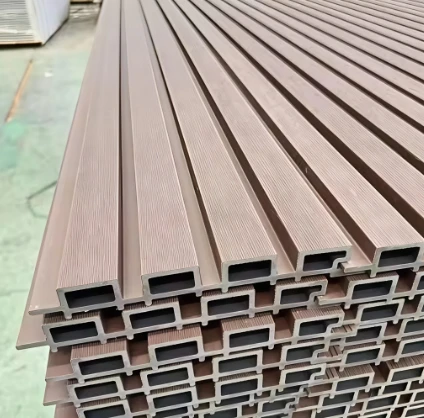
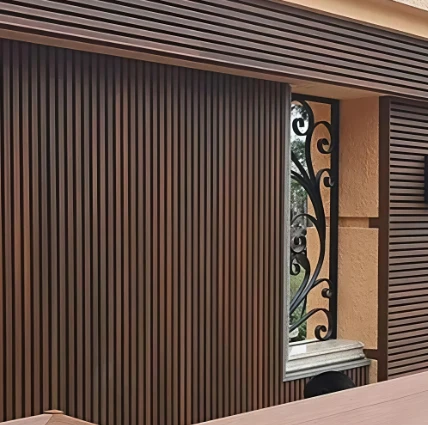
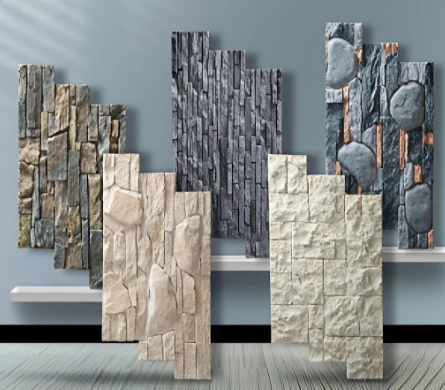
When I handle overseas customer inquiries, I am asked this question almost every month. The people asking are usually project managers at resort hotels, purchasing agents for villa owners, or architects developing detailed designs for beachfront clubs. Their concern is very specific: pool areas are permanently humid, exposed to chlorine-laden splash water and strong UV, and ordinary wooden wall panels cannot survive two summers without turning black, swelling, or warping. So, can outdoor WPC wall panels really be used in swimming pool areas?
My answer has always been: yes-and when the right product and installation method are used, it is one of the most cost-effective enclosure solutions available today. But this "yes" needs to be unpacked. It is not a sales line; it is the result of material performance, exposure conditions, and engineering details all working together.
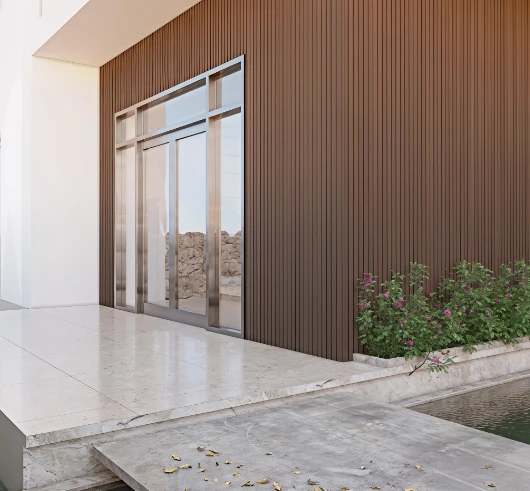

1. The Real Durability Boundaries of WPC in Pool Environments
WPC (wood-plastic composite) is made by compounding wood fiber or wood flour with a thermoplastic polymer-commonly PVC or PE-and extruding it into profiles. In a pool environment, the material faces three threats: water, chlorine, and UV. WPC can handle them because its formulation and structure establish clear resistance mechanisms against all three.
- Chlorine resistance. The available chlorine concentration in pool water is usually within the hygiene standard range of 1–3 ppm. At this concentration, WPC is stable against chlorine. Deceuninck, a leading profile manufacturer, clearly states in its technical documentation that WPC is chlorine-resistant and that permitted swimming pool chlorine concentrations are completely safe for the material. The only thing to avoid is direct splash from high-concentration chlorine solutions, which may cause localized fading. In other words, normal pool splash and chlorinated moisture do not pose a threat; residual daily cleaning chemicals are the edge case worth watching.
- Water absorption. This is the key indicator that separates "usable" from "not usable." Ordinary WPC usually has a water absorption rate of around 1%, while outdoor-grade, co-extruded WPC can keep water absorption at a very low level. Some engineering-grade products have a 24-hour water absorption rate below 0.2%, approaching "zero moisture absorption." The lower the water absorption, the lower the risk of swelling, warping, and mold growth during long-term wet–dry cycles.
- UV and color stability. Pool areas have no shade, so UV exposure is continuous. Ordinary WPC may develop surface chalking or color drift under long-term UV, but outdoor WPC wall panels with a co-extruded functional layer (ASA or a polymer capstock) show clear improvements in UV aging resistance and color retention. For light colors, woodgrain colors, and other designs sensitive to color difference, the co-extruded surface should be treated as the default option, not an upgrade.
Safety details: slip resistance and fasteners. People walk barefoot around pools frequently, so panel surfaces must be free of burrs and cracking risks. WPC itself does not produce wood splinters, and some outdoor profiles are designed with slip-resistant textures. More hidden but equally critical are the fasteners: in chlorinated and humid environments, ordinary carbon steel screws will rust and fail within months, so A4 (316) stainless steel fasteners must be used. It is not rare in engineering practice for a high-end WPC project to develop loosening within two years because the wrong screws were selected.
Table 1: Key Indicators and Recommended Thresholds for Outdoor WPC Wall Panels in Pool Areas
|
Key indicator |
Typical ordinary WPC |
Recommended standard for pool areas |
Why it matters |
|
24-hour water absorption |
About 1% or higher |
≤0.5%, preferably ≤0.2% |
Determines risk of swelling, warping, and mold |
|
Surface structure |
Through-color extrusion, no protective layer |
Co-extruded ASA/polymer protective layer |
UV resistance, color retention, reduced moisture penetration |
|
Fastener material |
Carbon steel / galvanized |
A4 (316) stainless steel |
Rust resistance in chlorinated humid environments |
|
Board-end treatment |
Exposed end faces |
End sealing or drainage guidance |
Board ends are the most common starting point for moisture deterioration |
|
Substrate material |
Ordinary timber frame |
Anti-corrosion/moisture-resistant substrate or WPC subframe |
Avoids panel remaining intact while substrate fails first |
|
Drainage design |
No defined slope |
Joint gaps and clear drainage slope |
Prevents standing water |
|
Maintenance method |
Sanding, sealing, painting |
Fresh water or neutral cleaner wipe-down |
Reduces whole-life maintenance cost |
2. Two Real Projects: Data Is More Convincing Than Promises
Case 1: Boutique Hotel Pool Area in Bali - 14 Months of High-Humidity Exposure, Zero Degradation
A boutique hotel in Bali renovated its pool area and adjacent walls in 2025. The original scheme used hardwood wall panels, but under local year-round relative humidity of 80–88% and temperatures of 24–32°C, the wood had to be sanded and re-sealed every six months. The maintenance burden was extremely high, and repeated moisture absorption caused dimensional instability.
The project team ultimately selected ASA/PVC co-extruded WPC wall panels. The ASA protective layer resists UV degradation and moisture penetration, while the PVC core maintains dimensional stability under continuous high humidity. Site records after 14 months of installation showed: zero mold, zero swelling, and zero color change, with no need for any sanding, sealing, or repainting maintenance. The hotel's maintenance manager said: the WPC panels have remained in a zero-maintenance state.
The core value of this case is not that "WPC looks good," but that it uses 14 months of measured data from a tropical pool environment to prove one thing: when WPC is supplied in a co-extruded, low-water-absorption form, the high humidity and frequent water exposure of a pool area do not constitute drivers of material degradation.
Case 2: Green Community Pool Renovation in Dubai - Systemic WPC Replacement After Old Timber Substrate Failure
A community pool area at Green Community in Dubai faced typical aging problems: the original uncapped old decking had faded and worn under long-term UV and moisture, and the timber subframe beneath had also warped due to poor early installation. The problem was not WPC itself, but that the previous-generation material scheme had not been systematically designed for the pool environment.
During the renovation, the contractor completely removed the failed old panels and deformed timber frame and replaced them with a WPC subframe system and a protected WPC decking/wall panel system. The logic of this renovation was: do not use WPC merely as a "replacement skin for wood," but make the supporting structure itself also moisture-resistant and dimensionally stable enough for the pool environment, thereby eliminating the hidden risk of "intact panels but failed substrate first."
Together, these two cases illustrate a judgment criterion that is easily overlooked: the success of WPC in pool areas depends half on the profile itself and half on system integrity. Chlorine resistance and low water absorption of the panel are necessary conditions; fastener grade, substrate material, drainage slope, and board-end sealing are equally important sufficient conditions.
Table 2: Recommended Configurations for Different Pool Scenarios
|
Scenario type |
Recommended profile |
Fasteners |
Substrate and installation points |
Maintenance expectation |
|
Hotel/resort pool area |
Co-extruded ASA/PVC WPC wall panel |
A4 stainless steel |
WPC or anti-corrosion subframe; clear joint drainage |
Routine wipe-down; no painting |
|
Private villa pool |
Co-extruded WPC wall panel, light/woodgrain colors |
A4 stainless steel |
Level substrate; seal board ends |
Quarterly check of fasteners and joints |
|
Seaside saltwater pool |
High-weathering co-extruded WPC; salt-mist-resistant hardware |
A4 stainless steel, 316L preferred |
Increase rinsing frequency; avoid salt crystal accumulation |
Regular fresh-water rinsing |
|
Indoor heated pool |
Co-extruded WPC wall panel |
A4 stainless steel |
Control condensation; ensure ventilation |
Low maintenance |
|
Old wall renovation |
Co-extruded WPC wall panel + independent battens |
A4 stainless steel |
Do not apply directly to old wall; retain drainage cavity |
Periodic inspection depending on substrate condition |
3. A Practical Checklist for Project Decision-Makers
If you are an owner, designer, or buyer evaluating wall solutions for a pool area, the following five questions can be used directly to screen suppliers and products-not just compare unit prices:
First, ask for water absorption data, not "waterproof or not." Require the supplier to provide a 24-hour water absorption test value. Below 0.5% is an acceptable starting point for pool areas; claims of "100% waterproof" without a numerical value have no reference value in engineering.
Second, ask whether it is co-extruded and what the functional layer material is. Outdoor WPC wall panels for pool areas should preferably use a co-extruded structure, with ASA or an equivalent weathering polymer as the functional layer. Ordinary through-color extruded panels show a clear gap in long-term color stability and surface integrity under combined UV and moisture exposure.
Third, ask about the fastener solution. In chlorinated or saline environments, A4 stainless steel is the bottom line. If the supplier's installation guide does not clearly specify the fastener material, that is a warning sign.
Fourth, ask about board-end and joint treatment. The most easily overlooked starting point for deterioration in pool areas is water absorption at board ends. During installation, board ends should be kept away from places where water can accumulate, joints should be gapped according to specifications and guided for drainage, and water should be prevented from remaining on wall surfaces for long periods.
Fifth, ask for cases, operating duration, and maintenance records. The best evidence of whether a WPC wall panel is truly suitable for a pool area is not an "applicable scenarios" icon in a product brochure, but a project that has already run for more than a full seasonal cycle and has maintenance records available for review.
Table 3: Maintenance Recommendations for WPC Wall Panels in Pool Areas
|
Maintenance item |
Frequency |
Key actions |
|
Routine cleaning |
Monthly or as needed |
Fresh-water rinse or soft-cloth wipe with neutral cleaner |
|
Joint and board-end inspection |
Quarterly |
Remove standing water, fallen leaves, and sediment |
|
Fastener inspection |
Every six months |
Confirm no rust and no loosening |
|
Saltwater pool rinsing |
Quarterly or as needed |
Fresh-water rinse to remove surface salt crystals |
|
Large-area stains |
As needed |
Avoid strong acids and alkalis; test a small area first |
|
Annual system inspection |
Annually |
Check substrate, drainage slope, and sealing integrity |
4. FAQ: Five Questions Customers Ask Most Often
Q1: Will outdoor WPC wall panels be corroded by chlorine in the pool?
A.Under normal pool hygiene standards, available chlorine concentration is usually 1–3 ppm, and WPC is stable at this concentration. What should be avoided is direct splash or long-term residue of high-concentration chlorine solutions. Daily splash and chlorinated moisture do not constitute a corrosion threat.
Q2: Will WPC wall panels be very slippery at the poolside?
A.Wall panels are mainly used for vertical surfaces and do not directly provide floor slip resistance. If used for poolside decking or bench surfaces, outdoor profiles with slip-resistant textures should be selected, and drainage slope should be ensured. The wall panel surface itself should be free of burrs and cracking risks.
Q3: Can WPC wall panels be applied directly to an old wall?
A.Direct adhesion is not recommended. In pool areas, a drainage cavity and ventilation conditions should be retained, and independent battens or a subframe should be used for installation. Direct application to an old wall blocks moisture escape and increases the risk of substrate failure.
Q4: Is maintenance cost high?
A.With correct product selection and installation, routine maintenance only requires fresh water or neutral cleaner wipe-down; no sanding, sealing, or repainting is needed. The main maintenance work is quarterly inspection of joints, board ends, and fasteners, plus regular rinsing for saltwater pools.
Q5: What advantages do WPC wall panels have compared with tiles and stone?
A.WPC is lighter, faster to install, and requires no wet mortar work. It does not produce wood splinters and is safe for barefoot contact. Compared with tiles, WPC wall panels are more flexible in facade renovation and old-wall retrofits; compared with natural wood, maintenance frequency is significantly lower. The final choice should still be based on design effect, budget, and substrate conditions.
Conclusion
Returning to the question in the title: Can outdoor WPC wall panels be used in swimming pool areas? The answer is yes. But this "yes" belongs to outdoor WPC wall panels that have low water absorption, a co-extruded weathering structure, matching A4 stainless steel fasteners, and are installed as a complete system. Ordinary indoor-grade or low-cost non-co-extruded WPC carries risks in pool areas that are no lower than those of traditional wood.
At Haining Longtime Industry Co., Ltd., our WPC wall panel solutions for pools and high-humidity outdoor applications include co-extruded weathering surfaces, tested moisture-resistant performance, and fastening and trim accessories that meet engineering requirements. Our technical team can provide targeted profile and installation recommendations based directly on your project's humidity level, chlorine exposure, and facade construction. If you are selecting materials for a pool project, you are welcome to send us your drawings and exposure conditions-confirm the system first, then confirm the product. This is the sequence we insist on in every pool project.
Isabella Hernandez
Senior Sales Manager, Haining Longtime Industry Co., Ltd.