Having spent over a decade in the building materials industry, I'm frequently asked by clients: "Can your WPC wall panels be installed on the ceiling?" And my response is always the same: Which specific product are you referring to?
That's a critical question, because in our WPC product line, the vast majority of wall panels are specifically designed for wall applications. Only select models-those with structural optimization, controlled weight, and compatible framing systems-are suitable for ceiling installation. Today, I want to clarify from a technical standpoint: when ceiling installation is feasible, when it's not recommended, and how to do it correctly.

Core Principle: Primarily for Walls, Selectively for Ceilings
WPC wall panels have proven themselves exceptionally well in wall applications-offering moisture resistance, durability, aesthetic versatility, and easy installation. However, ceiling applications present a different set of engineering challenges that must simultaneously satisfy:
- Lightweight construction: Excessive panel weight increases the load on framing and structural slabs, creating safety risks.
- Sag resistance: When installed horizontally, panels are subject to deflection (bending deformation) under gravity, requiring higher rigidity and creep resistance.
- Fire ratings: Different spaces have varying fire safety requirements for ceilings, and some WPC formulations may not meet the standards required for certain commercial settings.
- Expansion control: Thermal movement is more pronounced in ceiling installations, requiring properly sized expansion gaps to prevent buckling or cracking.
Therefore, our company has always maintained a clear position: unless a product is specifically labeled as "ceiling-compatible," standard WPC wall panels should be prioritized for wall use.
Which WPC Products Are Suitable for Ceiling Installation?
Through extensive testing and project validation, Haining Longtime Industry Co., Ltd. has identified the following product categories as suitable for ceiling applications:
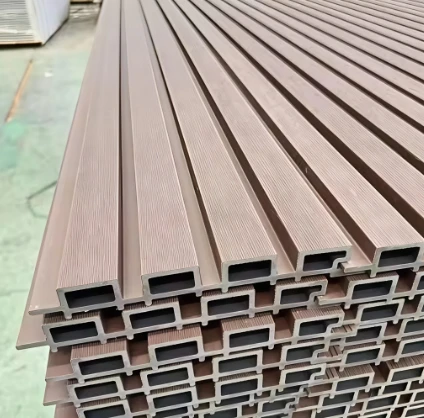
- Lightweight Hollow Core Series - Featuring a hollow-core structure that significantly reduces self-weight while maintaining adequate flexural strength. Ideal for small-span ceilings in residential balconies, corridors, and bathrooms.
- Reinforced Co-Extrusion Series - With a high-hardness co-extruded surface layer that enhances overall rigidity and sag resistance. Suitable for commercial spaces such as offices and restaurants.
- Dedicated Ceiling Framing Systems - We have developed specialized light-gauge steel framing and suspension accessories specifically for ceiling applications, effectively distributing loads and ensuring long-term performance without sagging.
For these approved products, we provide detailed load data and installation guidelines. For all other solid wall panels, we do not recommend ceiling installation.
Key Technical Requirements for Ceiling Installation (Applicable Only to Compatible Products)
If you are using our ceiling-specific series, please adhere to the following installation principles:
- Specialized framing is mandatory: Panels must never be fixed directly to the structural slab. A suspension system of hangers plus primary and secondary framing members is required.
- Span control: Individual panel spans should not exceed 1.2 meters (depending on the specific model). Greater spans require increased framing density.
- Expansion gaps: Leave 2–3mm gaps between panels, concealed with trim pieces, to accommodate thermal expansion and prevent buckling.
- Independent fixture suspension: All lighting, ventilation, and other equipment must be independently suspended from the structural slab-never attached directly to the WPC panels.
Attempting to install standard wall panels on a ceiling without proper approval is an absolute safety red line-at best, it will result in wavy deformation; at worst, panels may detach and fall.
Real-World Case Study: Residential Balcony Ceiling in Hangzhou
Mr. Wang, a homeowner in Hangzhou, wanted his balcony ceiling to combine the natural texture of preservative-treated wood with reliable moisture protection for the region's humid plum rain season. He initially considered solid wood but worried about mold and deformation. After learning about WPC materials, he contacted us to ask whether our wall panels could be installed directly on his balcony ceiling.
We clarified immediately that standard wall panels are not suitable for ceiling applications-but our Lightweight Hollow Core Ceiling-Specific Panels were exactly what he needed. Our technical team then developed a customized framing plan based on the balcony's actual dimensions (3.6 meters long × 1.5 meters wide, with a 1.1-meter span) and provided on-site installation guidance-using a dedicated light-gauge steel suspension system, leaving expansion gaps between panels, and independently suspending light fixtures from the structural slab.
After installation, Mr. Wang was thoroughly satisfied. The visual effect was fully comparable to solid wood, but without the moisture concerns. After two full summer seasons and plum rain periods in Hangzhou (outdoor humidity frequently exceeded 80%), the ceiling remained perfectly flat-no sagging, no mold, no fading. Routine maintenance simply involves light dusting with a feather duster. Mr. Wang remarked: "If I'd known WPC ceilings were this low-maintenance, I would have done the bathroom too."
This case reinforces our core message: the right product selection + proper installation = WPC ceilings that perform reliably and outlast traditional materials with far less upkeep.
Frequently Asked Questions
Q1: I already purchased standard wall panels. Can I use them for my ceiling?
A: We strongly advise against it. Standard wall panels have higher density and weight, and their flexural performance is not optimized for horizontal installation, making them highly prone to deformation. If you've already purchased them, we recommend using them exclusively for walls and selecting ceiling-specific products for your overhead application.
Q2: Is there a significant price difference between ceiling-specific panels and standard wall panels?
A: Ceiling-specific panels are slightly higher in price due to their structural design and material formulation, but the difference is within an acceptable range. Compared to the cost of future repairs or replacement, this upfront investment is well worth it.
Q3: How can I determine whether my project is suitable for WPC ceiling panels?
A: Please provide your space dimensions, environmental conditions, and design preferences. Our technical team will evaluate your project and recommend the most appropriate product.
Closing Thoughts
As a responsible WPC manufacturer, Haining Longtime Industry Co., Ltd. stands by the principle of "the right product for the right application." We do not promote WPC as a "one-size-fits-all" solution. Instead, we encourage every client to select the correct material for their specific needs and to follow proper installation practices. For walls, trust our wall panels; for ceilings, choose our ceiling-specific series-and always install according to our guidelines.
If you are considering WPC for your ceiling project, please don't hesitate to reach out to me or our technical team. We will provide detailed load reports, connection details, and installation recommendations. Let every panel serve its purpose, and let every space be both beautiful and safe.
Isabella Hernandez
Senior Business Manager
Haining Longtime Industry Co., Ltd.