In the outdoor flooring industry, the most deceptive thing about a material is how it looks right after installation. Pressure-treated wood looks like a forest when first installed; tile looks like a hotel; freshly poured concrete looks like an art gallery. But after one rainy season, one summer, and a group of barefoot guests, the truth comes out. At Haining Longtime Industry, when we say WPC flooring, we mean outdoor wood-plastic composite decking-extruded from a blend of wood flour and plastic, used for terraces, poolside areas, garden walkways, and commercial landscapes, not indoor click-lock flooring. I'm Michael Wilson, Senior Business Manager at the company. Over the past decade or so, I've seen pressure-treated wood grow mold and splinter, tile become slippery when wet, and solid wood dragged down by maintenance budgets. So in this article, I want to compare WPC outdoor decking, pressure-treated wood, natural hardwood, tile, and concrete under the same set of standards, and explain clearly whether WPC is really worth choosing.
First, What Exactly Is Outdoor WPC?
Outdoor WPC is commonly called WPC decking or wood-plastic composite decking. Its core raw materials are wood flour or plant fibers, combined with thermoplastics such as HDPE, PE, or PP, along with UV stabilizers, anti-mold agents, colorants, and slip-resistant additives. It is formed through high-temperature extrusion.
There are two common types of outdoor WPC decking on the market:
- Non-co-extruded WPC: Uniform color throughout, lower cost, but more noticeable color change after long-term sun and rain exposure.
- Co-extruded WPC: Has a co-extruded protective layer on the surface, usually more stain-resistant, scratch-resistant, and fade-resistant. It is currently the mainstream choice for mid-to-high-end projects.
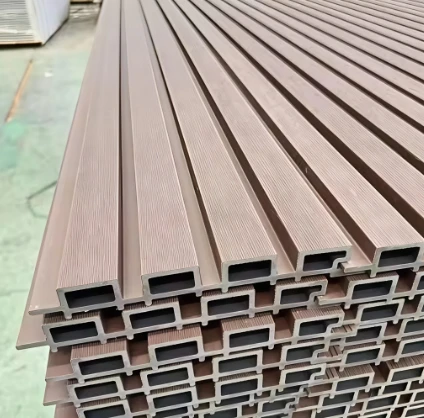
Structurally, there are also hollow and solid options. Hollow boards are lighter, use less material, and ventilate well; solid boards are heavier, more stable, and better at load-bearing. Which one to choose depends on whether the project is a rooftop terrace, poolside area, or high-traffic commercial walkway.


Six Key Dimensions: WPC Outdoor Decking vs. Pressure-Treated Wood, Solid Wood, Tile, and Concrete
1. Weather Resistance, Rot Resistance, and Insect Resistance: WPC's Advantage Is the Most Obvious
Outdoor decking fears three things most: water, mold, and insects.
- Pressure-treated wood, such as pressure-treated pine, has a low initial price and natural wood grain. But it is still wood at its core: it swells when wet, shrinks when dry, and over time is prone to cracking, splintering, and mold. Preservative treatment can delay rot, but it cannot cure it. Especially around pools, near the coast, or in regions with long rainy seasons, pressure-treated wood creates enormous maintenance pressure.
- Natural hardwoods, such as teak, ipe, and merbau, have better weather resistance than ordinary pressure-treated wood, and they offer a premium feel and appearance. But they are expensive, demanding to install, and will turn gray after long exposure; they require regular oiling or coating. Their surfaces also become slippery when wet.
Tile is not afraid of water or insects, but it is a hard material. When wet, it poses a high slip risk, and grout lines are prone to mold. It is cold in winter and hot in summer, making for a poor barefoot experience.
Concrete is sturdy, inexpensive, and long-lasting, but it cracks, dusts, and holds water. Its appearance is industrial, making it unsuitable for high-end terraces and poolside areas.
WPC outdoor decking does not absorb water, does not rot, does not attract termites, and is not prone to splintering. High-quality co-extruded WPC performs stably under UV, rain, and temperature fluctuations, making it suitable for long-term outdoor use. Its weakness is thermal expansion and contraction; during installation, expansion gaps must be left according to specifications, and joist spacing must be strictly controlled.
2. Waterproofing and Slip Resistance: WPC Is More Stable Than Wood and Safer Than Tile
Outdoor decking cannot avoid water. Around pools, on terraces, and along walkways, rain, washing, and splashing are the norm.
The plastic content in WPC makes it virtually non-water-absorbent; water simply runs off the surface. After wood-grain embossing or brushing treatment, the risk of slipping is lower than that of tile and natural hardwood. Tile is very safe when dry, but once water and algae are present, it becomes extremely slippery. Pressure-treated wood and hardwood also become slippery when wet, especially after moss grows on the surface.
However, WPC is not "never slippery." If the surface is not cleaned for a long time and accumulates mud, algae, or grease, it will still be slippery. So let me put it plainly: WPC is low-maintenance, not maintenance-free.
3. Feel Underfoot and Temperature: WPC Is More Comfortable Than Tile and Concrete
If you have ever walked barefoot on a tile terrace in summer, you know what I mean. Tile and concrete become very hot on the surface in sunlight and are freezing cold in winter. Natural wood feels the best underfoot, but its maintenance costs are high.
4. Maintenance Cost: WPC Wins on the Long-Term Ledger
This is where many customers make the biggest miscalculation.
- Pressure-treated wood is cheap initially, but it needs to be cleaned, sanded, and re-oiled or repainted every year or every two years. In coastal and humid areas, the frequency is even higher. Once labor and business interruption costs are added in, after five years the total often exceeds the initial material price difference.
- Natural hardwood is more expensive, and maintenance cannot be skipped. Without oiling, it turns gray; with oiling, it becomes an ongoing cost.
- Tile looks easy to clean, but grout can grow mold and turn black, requiring pressure washing and re-grouting.
- Concrete is low-maintenance, but cracks, stains, and dusting are hard to avoid, and renovation is troublesome.
- WPC outdoor decking requires only sweeping and rinsing with clean water for routine maintenance, with a mild neutral cleaner when necessary. Co-extruded products offer better stain resistance and do not require painting, staining, or sealing. Its full life-cycle cost is usually lower than that of pressure-treated wood and natural hardwood, especially in high-traffic commercial projects.
5. Dimensional Stability and Installation: WPC Needs Gaps; Tile and Concrete Are More Rigid
WPC outdoor decking expands and contracts with temperature changes. This is not a quality problem; it is a material characteristic. During installation, expansion gaps must be left, and joist spacing, fastening methods, and ventilation layers must follow the manufacturer's specifications. Done properly, WPC can be very stable; done improperly, it will buckle and curl at the edges.
Tile and concrete are more dimensionally stable, but their installation is complex and places high demands on the substrate. Tile requires a leveling layer and adhesive layer; concrete requires pouring and curing. Pressure-treated wood and natural hardwood also change with humidity and are even more prone to cracking and deformation.
So the installation barrier for WPC is not in the material itself, but in construction standards. Choosing the right supplier also means choosing the right installation team.
6. Appearance and Environmental Friendliness: WPC Mimics Wood, Solid Wood Is Natural, Tile and Concrete Are Hard
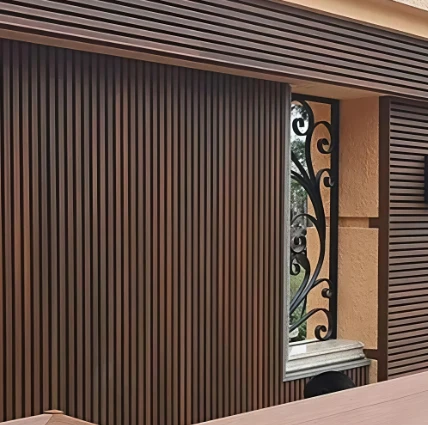
One of the biggest selling points of WPC outdoor decking is its appearance. It can be made in a variety of wood grains and colors-teak, walnut, gray wood, charcoal, and more-with embossed, brushed, or grooved surface treatments. From a distance, it resembles natural wood, but its color consistency is better and color variation is controllable.
The texture and feel of natural solid wood are irreplaceable, but it turns gray, cracks, and varies in color. Tile and concrete are colder and harder, suitable for modern styles but lacking the warmth of wood.
In terms of environmental friendliness, high-quality WPC can use recycled plastic and wood flour, and the product itself is recyclable. Pressure-treated wood contains chemical preservatives; natural hardwood depends on whether it comes from sustainably certified forests; tile and concrete have relatively higher energy consumption and carbon emissions. When choosing WPC, ask the supplier for environmental test reports and recycling documentation-don't just take the word "eco-friendly" at face value.
A Table to See the Differences Clearly
|
Dimension |
WPC Outdoor Decking |
Pressure-Treated Wood |
Natural Hardwood |
Tile |
Concrete |
|
Rot and insect resistance |
Excellent |
Moderate; depends on treatment |
Medium-high |
Excellent |
Excellent |
|
Waterproofing |
Excellent |
Poor |
Poor |
Excellent |
Moderate; absorbs water and cracks |
|
Slip resistance |
Good; depends on surface |
Slippery when wet |
Slippery when wet |
Slippery when wet |
Moderate |
|
Feel underfoot and temperature |
Warm and comfortable |
Warm |
Warm |
Cold/hot |
Cold/hot |
|
Maintenance |
Low |
High |
Medium-high |
Low, but grout is troublesome |
Low, but cracks are troublesome |
|
Appearance |
Wood-look, multiple colors, good consistency |
Natural, turns gray easily |
Premium natural |
Tile texture |
Industrial |
|
Installation |
Modular; requires expansion gaps |
Moderate |
Medium-high |
High |
High |
|
Lifespan |
15–25 years+ |
10–15 years |
20–30 years |
20 years+ |
30 years+ |
|
Initial cost |
Medium-high |
Low |
High |
Medium-high |
Medium |
|
Long-term cost |
Low |
High |
High |
Medium |
Medium |
Two Lessons from Real Projects
Case 1: Poolside Terrace Renovation at a Southeast Asian Resort Hotel
This is a project we followed a few years ago. The client was a beachfront resort hotel in Southeast Asia and asked not to be named. The poolside terrace and walkways originally used pressure-treated wood, covering about 1,200 square meters. After several years of operation, problems broke out all at once: mold during the rainy season, splintering boards, cracked edges, uncomfortable barefoot walking for guests, and a maintenance team that had to sand and recoat twice a year-costly and disruptive to business.
Later, they switched to our co-extruded WPC outdoor decking: hollow structure, hidden clips, stainless steel screws, tighter joist spacing according to specifications, and sufficient expansion gaps at all edge and wall junctions. After installation, the poolside area no longer needed annual oiling; daily maintenance became sweeping plus regular rinsing with clean water.
A follow-up visit 18 months after operation brought this feedback from the client: no rot, no splintering, no structural cracking; the slippery feel around the pool was significantly improved; and barefoot comfort was better than with the original pressure-treated wood. The client's internal estimate showed annual maintenance costs dropped by about 40%. This project later became a reference case for us in the Southeast Asian hotel channel.
Case 2: Rooftop Terrace and Garden Walkways at a Boutique Apartment Project in Hangzhou
The second case is in Hangzhou, a boutique apartment project with a rooftop terrace and garden walkways totaling about 800 square meters. The original plan was tile plus partial pressure-treated wood. The developer later found two problems: tile was cold in winter and hot in summer, and grout was prone to mold; pressure-treated wood required frequent maintenance, and the property management company was unwilling to invest in it long term.
In the end, they chose 23mm co-extruded WPC outdoor decking in teak color, with a slip-resistant surface texture, paired with an adjustable joist system. After installation, the rooftop terrace had a stronger overall visual coherence, the walkways felt more comfortable underfoot than tile, and the property management only needed routine cleaning. A follow-up visit two years later showed no warping or structural cracking; the color had faded slightly and evenly, but there was no paint peeling. The property management reported lower maintenance costs than the original plan, and both owners and tenants used the terrace noticeably more often.
Conclusion: Who Is WPC Outdoor Decking For?
My conclusion has always been clear: there is no "best" outdoor flooring, only the "best match."
If you want extremely low initial cost and are willing to maintain it every year, pressure-treated wood may suit you. If you pursue the premium feel of natural wood and have a sufficient budget, natural hardwood remains irreplaceable. If you need extreme load-bearing capacity and a permanent structure, concrete is more suitable. If you want waterproofing, slip resistance, a wood-like appearance, low maintenance, and controllable full life-cycle cost, WPC outdoor decking is currently the most balanced choice.
But choosing WPC also involves several key points: check the core material, whether it is co-extruded, the UV stabilizers and slip-resistant treatment, the joist system and installation specifications, and the warranty terms. Don't compare only the price per square meter; compare the total cost after five or ten years.
At Haining Longtime Industry, we are not just selling a board; we help customers get outdoor terraces, poolside areas, walkways, and commercial landscapes right. If you have a specific project, feel free to contact our technical team directly. We can provide more specific selection advice based on dimensions, climate, foot traffic, and installation conditions.